The Comonad.Readertypes, (co)monads, substructural logic

Purely Functional Data Structures for On-Line LCA

Edward Kmett

Slides on skew-binary representations and online lowest-common-ancestor search.

Related article: On-line Lowest Common Ancestor.

43 slides · Start reading
Purely Functional Data Structures
         for On-line LCA
            Edward Kmett
Slide 1 of 43 ·
Overview
The Lowest Common Ancestor (LCA) Problem

Tarjan’s Off-line LCA

Off-line Tree-Like LCA

Off-line Range-Min LCA

Naïve On-line LCA

Data Structures from Number Systems

Skew-Binary Random Access Lists

Skew-Binary On-line LCA
Slide 2 of 43 · ·
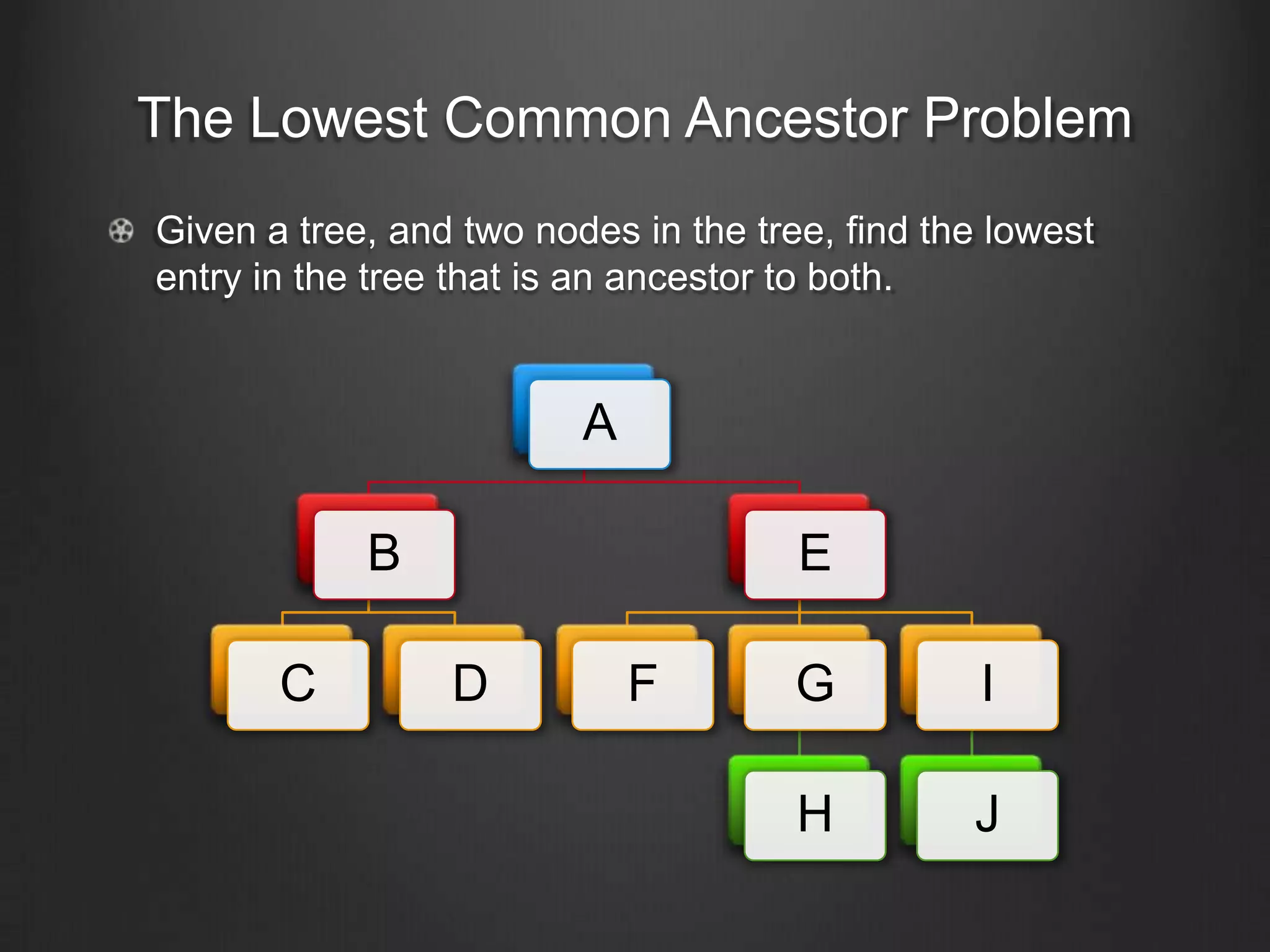
The Lowest Common Ancestor Problem
Given a tree, and two nodes in the tree, find the lowest
entry in the tree that is an ancestor to both.


                         A

            B                         E

       C         D           F        G          I

                                      H         J
Slide 3 of 43 · ·
Slide 4 of 43 · ·
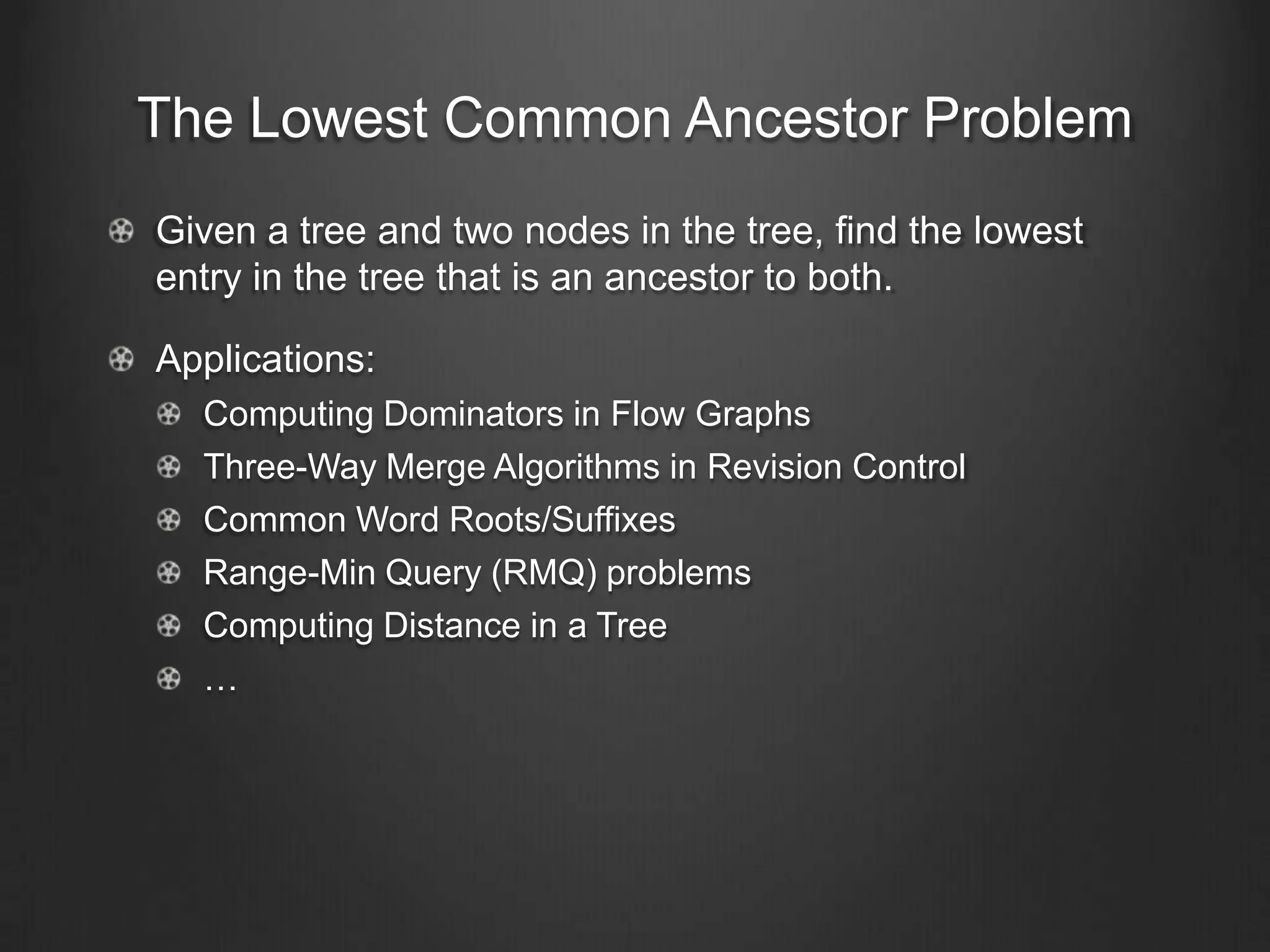
The Lowest Common Ancestor Problem
Given a tree and two nodes in the tree, find the lowest
entry in the tree that is an ancestor to both.

Applications:
  Computing Dominators in Flow Graphs
  Three-Way Merge Algorithms in Revision Control
  Common Word Roots/Suffixes
  Range-Min Query (RMQ) problems
  Computing Distance in a Tree
  …
Slide 5 of 43 · ·
The Lowest Common Ancestor Problem
Given a tree and two nodes in the tree, find the lowest
entry in the tree that is an ancestor to both.

First formalized by Aho, Hopcraft, and Ullman in 1973.

They provided ephemeral on-line and off-line versions of
the problem in terms of two operations, with their off-line
version of the algorithm requiring O(n log*(n)) and their
online version requiring O(n log n) steps.

Research has largely focused on the off-line versions of
this problem where you are given the entire tree a priori.
Slide 6 of 43 · ·
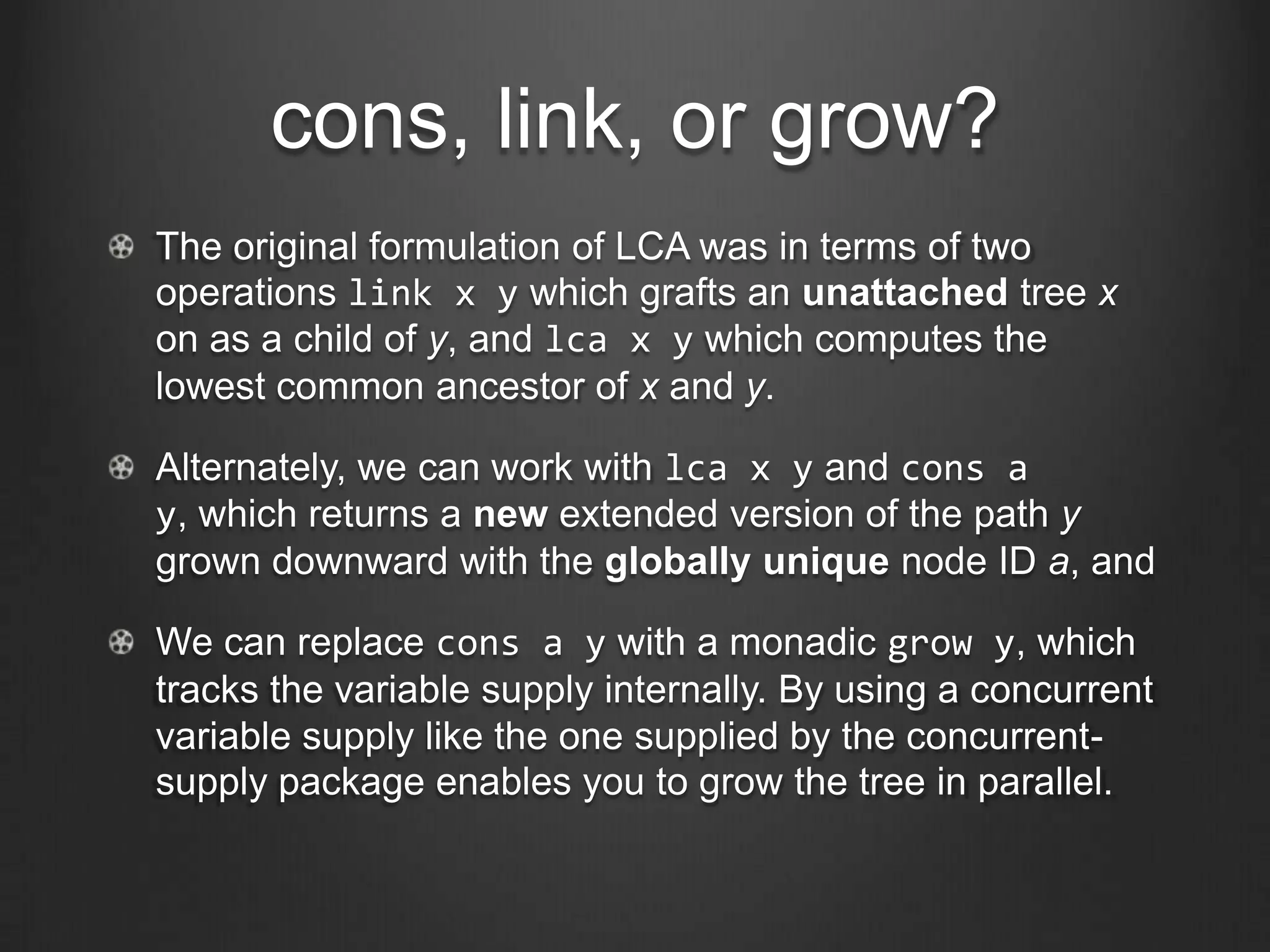
cons, link, or grow?
The original formulation of LCA was in terms of two
operations link x y which grafts an unattached tree x
on as a child of y, and lca x y which computes the
lowest common ancestor of x and y.

Alternately, we can work with lca x y and cons a
y, which returns a new extended version of the path y
grown downward with the globally unique node ID a, and

We can replace cons a y with a monadic grow y, which
tracks the variable supply internally. By using a concurrent
variable supply like the one supplied by the concurrent-
supply package enables you to grow the tree in parallel.
Slide 7 of 43 · ·
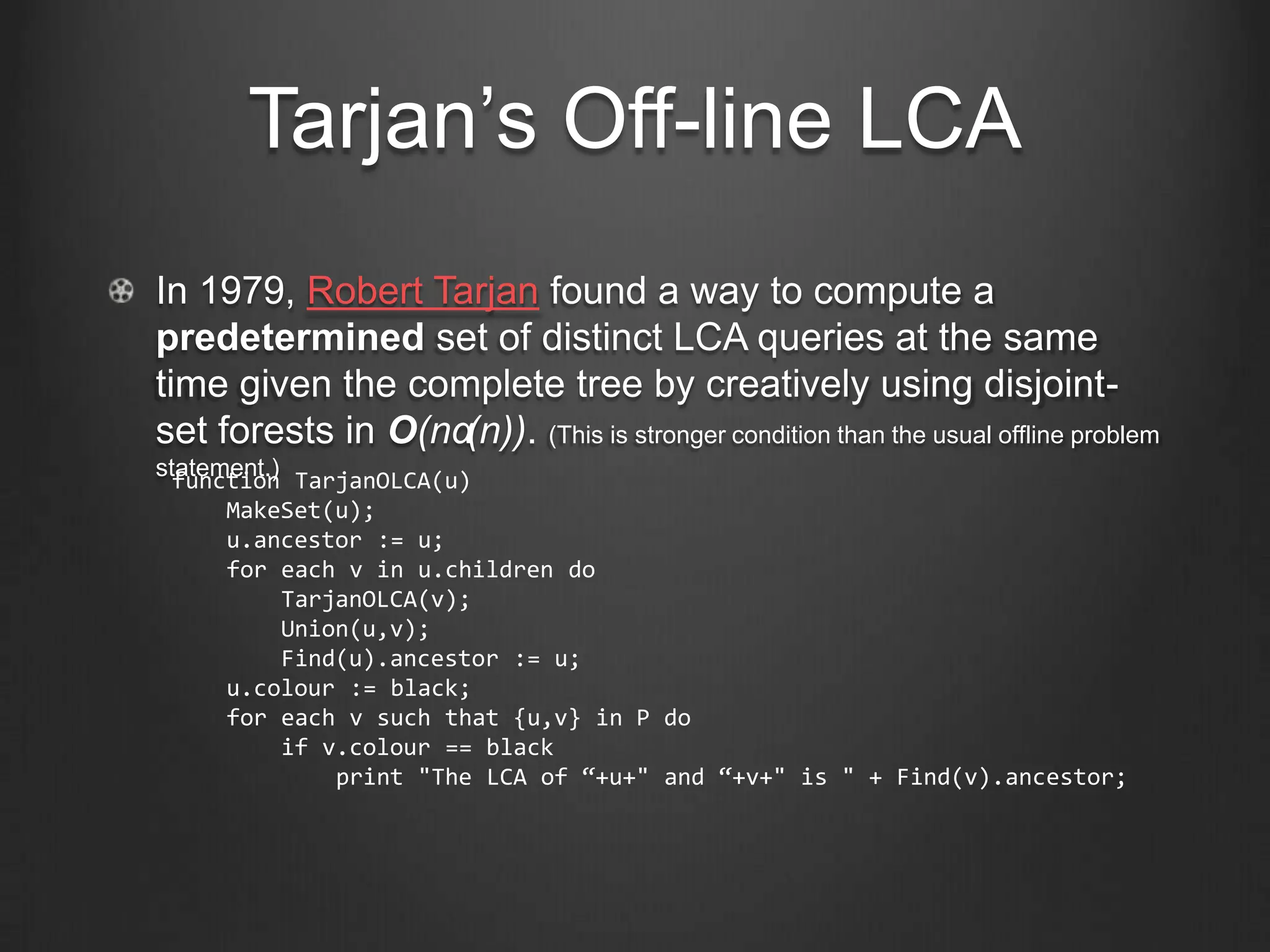
Tarjan’s Off-line LCA
In 1979, Robert Tarjan found a way to compute a
predetermined set of distinct LCA queries at the same
time given the complete tree by creatively using disjoint-
set forests in O(nα(n)). (This is stronger condition than the usual offline problem
statement.) TarjanOLCA(u)
  function
      MakeSet(u);
      u.ancestor := u;
      for each v in u.children do
           TarjanOLCA(v);
           Union(u,v);
           Find(u).ancestor := u;
      u.colour := black;
      for each v such that {u,v} in P do
           if v.colour == black
               print "The LCA of “+u+" and “+v+" is " + Find(v).ancestor;
Slide 8 of 43 · ·
Tarjan’s Off-line LCA
In 1979, Robert Tarjan found a way to compute a
predetermined set of distinct LCA queries at the same
time given the complete tree by creatively using disjoint-
set forests in O(nα(n)).

In 1983, Harold Gabow and Robert Tarjan improved the
asymptotics of the preceding algorithm to O(n) by noting
special-case opportunities not available in general
purpose disjoint-set forest problems.
Slide 9 of 43 · ·
Tree-Like Off-line LCA
In 1984, Dov Harel and Robert Tarjan provided the first
asymptotically optimal off-line solution, which converts the
tree in O(n) into a structure that can be queried in O(1).

In 1988, Baruch Scheiber and Uzi Vishkin simplified that
structure, by building arbitrary-fanout trees out of paths
and binary trees, and providing fast indexing into each
case.
Slide 10 of 43 · ·
Range-Min Off-line LCA
In 1993, Omer Berkman and Uzi Vishkin found another
conversion with the same O(n) preprocessing using an
Euler tour to convert the tree structure into a Range-Min
structure, that can be queried in O(1) time.
This was improved in 2000 by Michael Bender and Martin
Farach-Colton.
Alstrup, Gavoille, Kaplan and Rauhe focused on
distributing this algorithm.
Fischer and Heun reduced the memory requirements, but
also show logarithmically slower RMQ algorithms are
often faster the common problem sizes of today!
Slide 11 of 43 · ·
Backup Plans
Slide 12 of 43 · ·
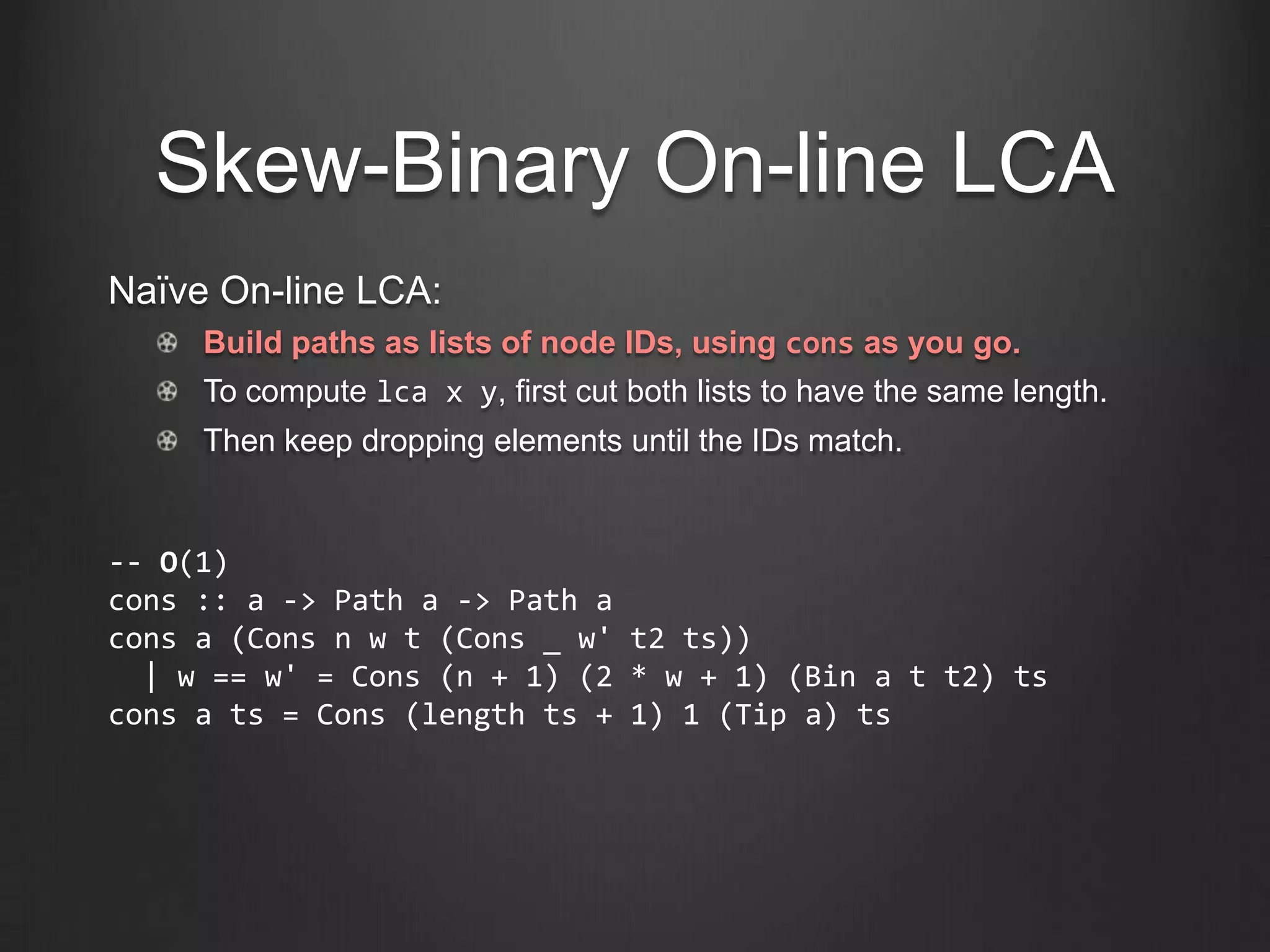
Naïve On-line LCA
Build paths as lists of node IDs, using cons as you go.

    x = [5,4,3,2,1] :# 5
    y = [6,3,2,1] :# 4

To compute lca x y, first cut both lists to have the same
length.

    x’ = [4,3,2,1], y’ = [6,3,2,1], len = 4

Then keep dropping elements from both until the IDs
match.

    lca x y = [3,2,1] :# 3
Slide 13 of 43 · ·
Naïve On-line LCA
No preprocessing step.

O(h) LCA query time where h is the length of the path.

O(1) to extend a path.

No need to store the entire tree, just the paths you are
currently using. This helps with distribution and
parallelization.

As an on-line algorithm, the tree can grow without
requiring costly recalculations.
Slide 14 of 43 · ·
Naïve On-line LCA
To go faster we’d need to extract a common suffix in
sublinear time. Very Well…
Slide 15 of 43 · ·
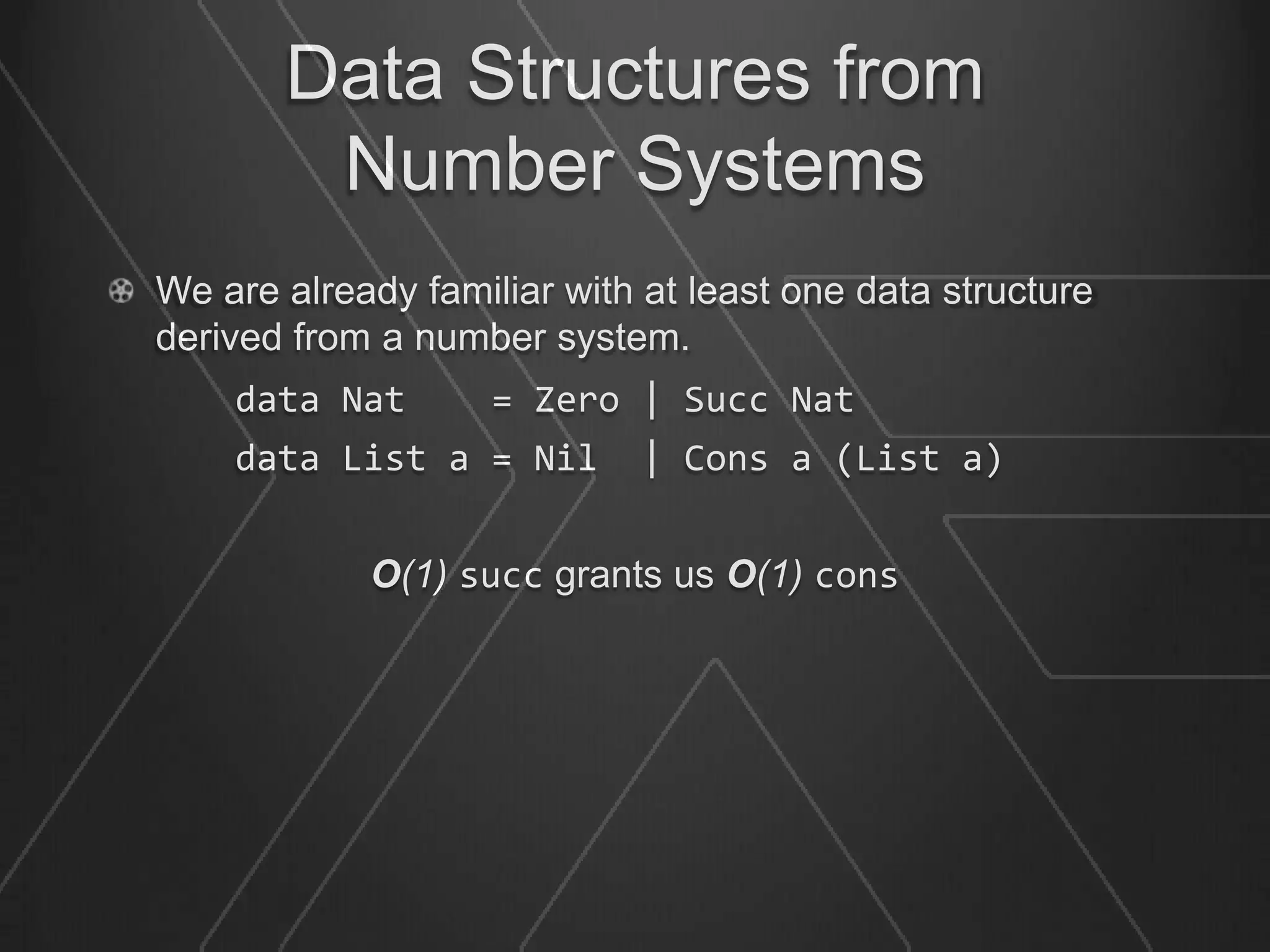
Data Structures from
        Number Systems
We are already familiar with at least one data structure
derived from a number system.
    data Nat        = Zero | Succ Nat
    data List a = Nil        | Cons a (List a)


            O(1) succ grants us O(1) cons
Slide 16 of 43 · ·
Binary Random-Access
           Lists
We could construct a data structure from binary numbers
as well, where you have a linked list of “flags” with 2n
elements in them.

However, adding 1 to a binary number can affect all log n
digits in the number, yielding O(log n) cons.
Slide 17 of 43 · ·
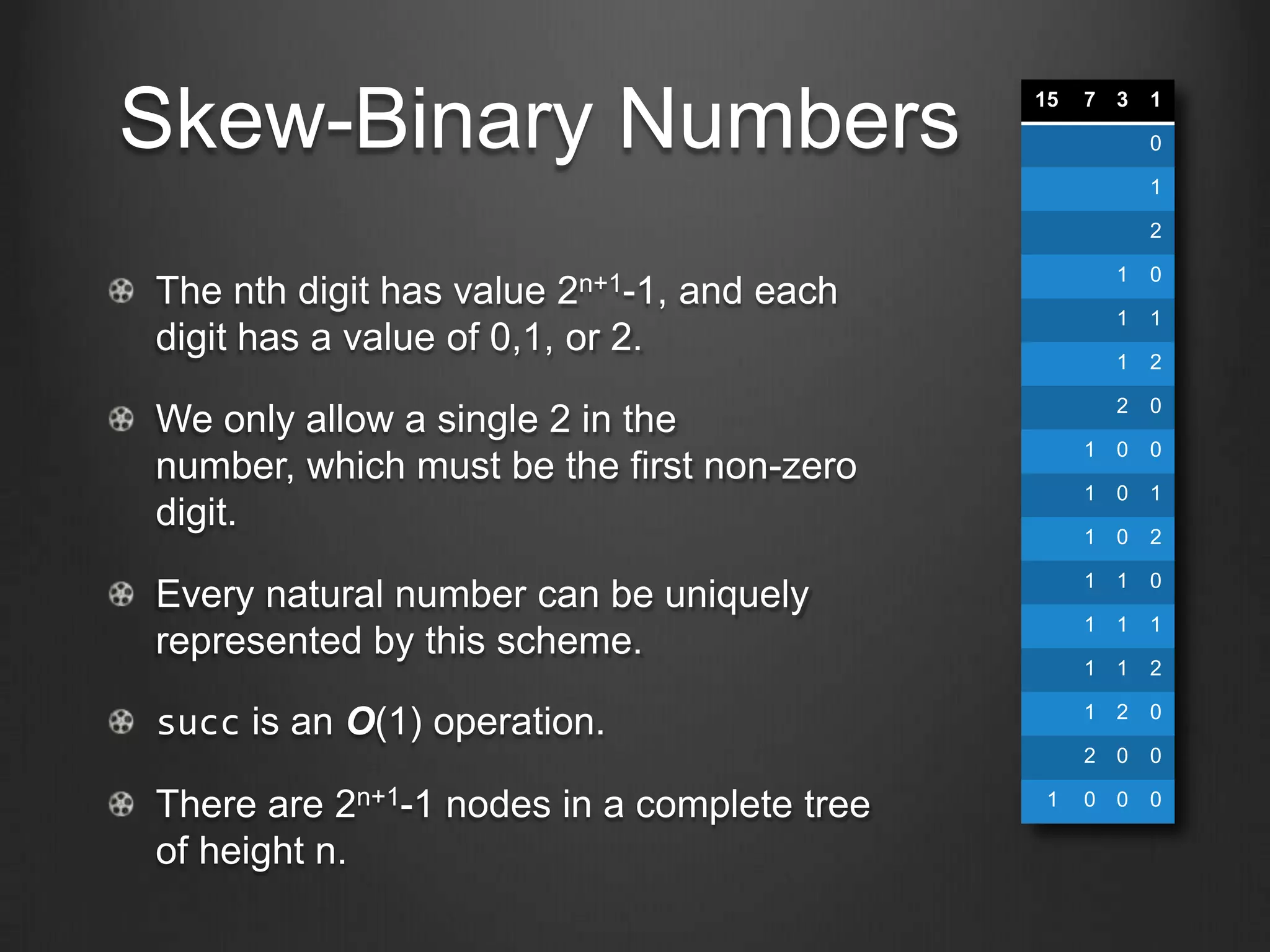
Skew-Binary Numbers                         15   7 3   1

                                                       0

                                                       1

                                                       2

                                                   1   0
The nth digit has value2n+1-1,  and each
                                                   1   1
digit has a value of 0,1, or 2.                    1   2

                                                   2   0
We only allow a single 2 in the
                                                 1 0   0
number, which must be the first non-zero
                                                 1 0   1
digit.                                           1 0   2

                                                 1 1   0
Every natural number can be uniquely
                                                 1 1   1
represented by this scheme.
                                                 1 1   2

                                                 1 2   0
succ is an O(1) operation.
                                                 2 0   0

There are 2n+1-1 nodes in a complete tree    1   0 0   0

of height n.
Slide 18 of 43 · ·
Skew-Binary Random Access
             Lists
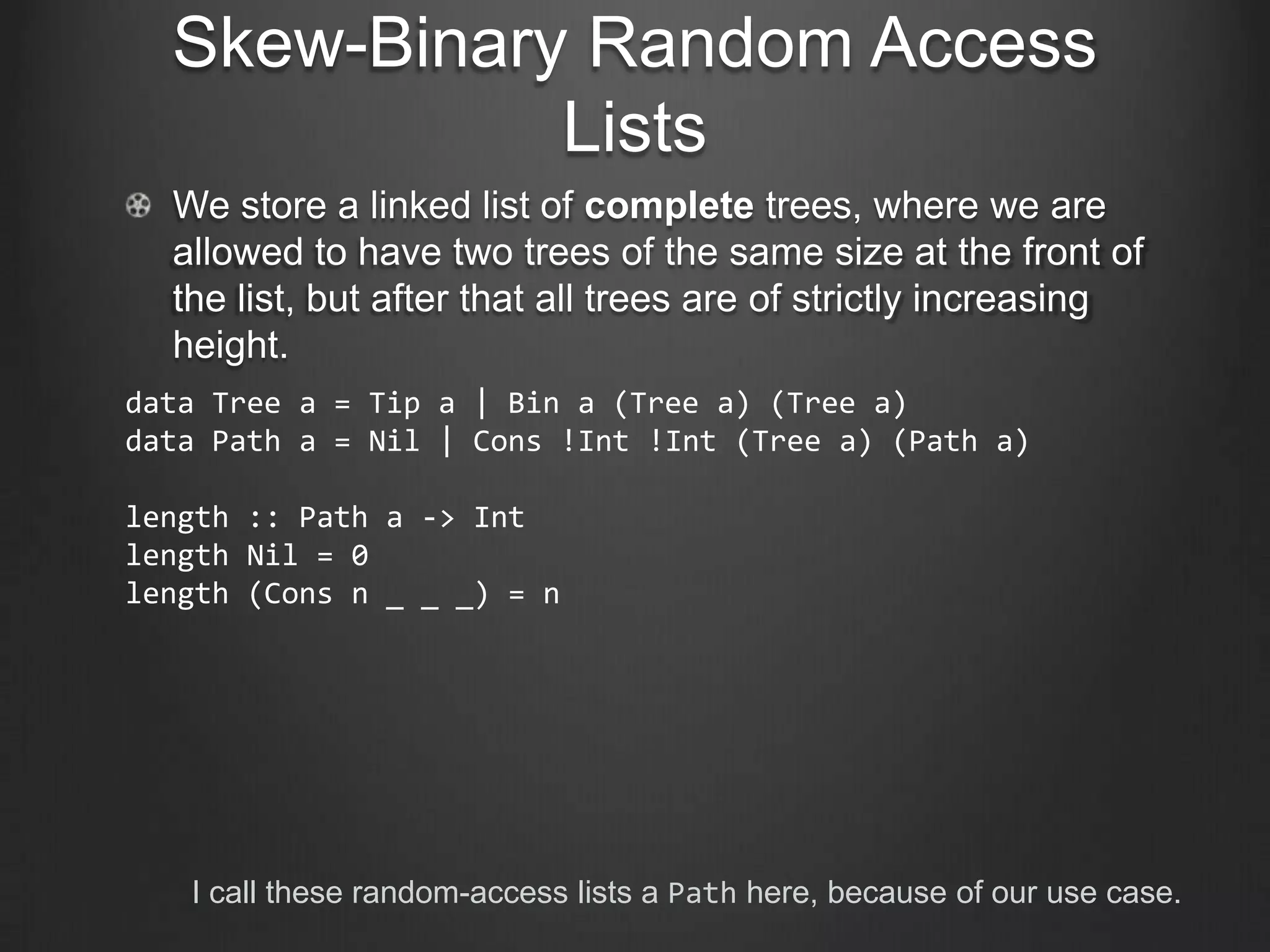
  We store a linked list of complete trees, where we are
  allowed to have two trees of the same size at the front of
  the list, but after that all trees are of strictly increasing
  height.
data Tree a = Tip a | Bin a (Tree a) (Tree a)
data Path a = Nil | Cons !Int !Int (Tree a) (Path a)

length :: Path a -> Int
length Nil = 0
length (Cons n _ _ _) = n


   I call these random-access lists a Path here, because of our use case.
Slide 19 of 43 · ·
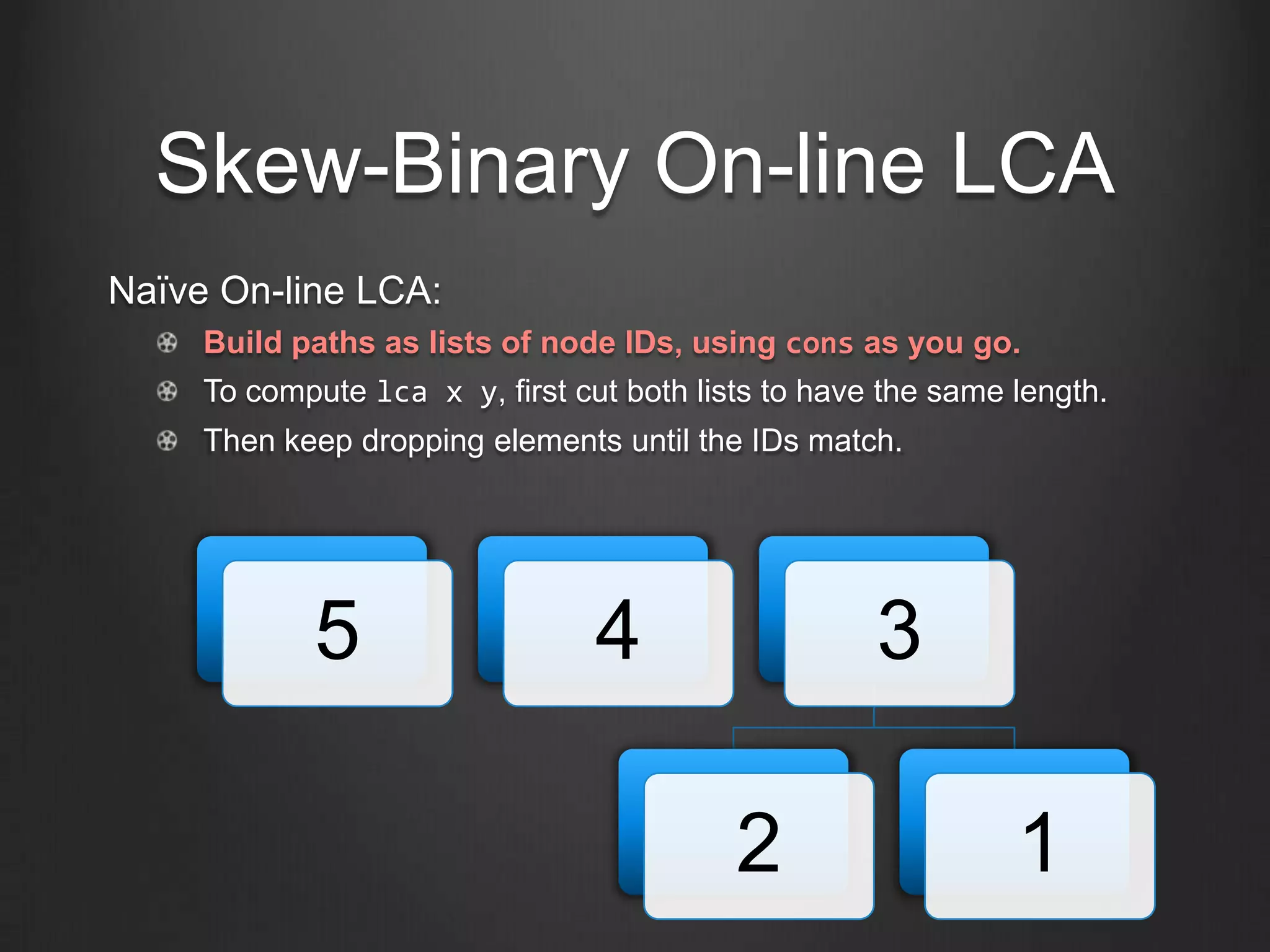
Skew-Binary On-line LCA
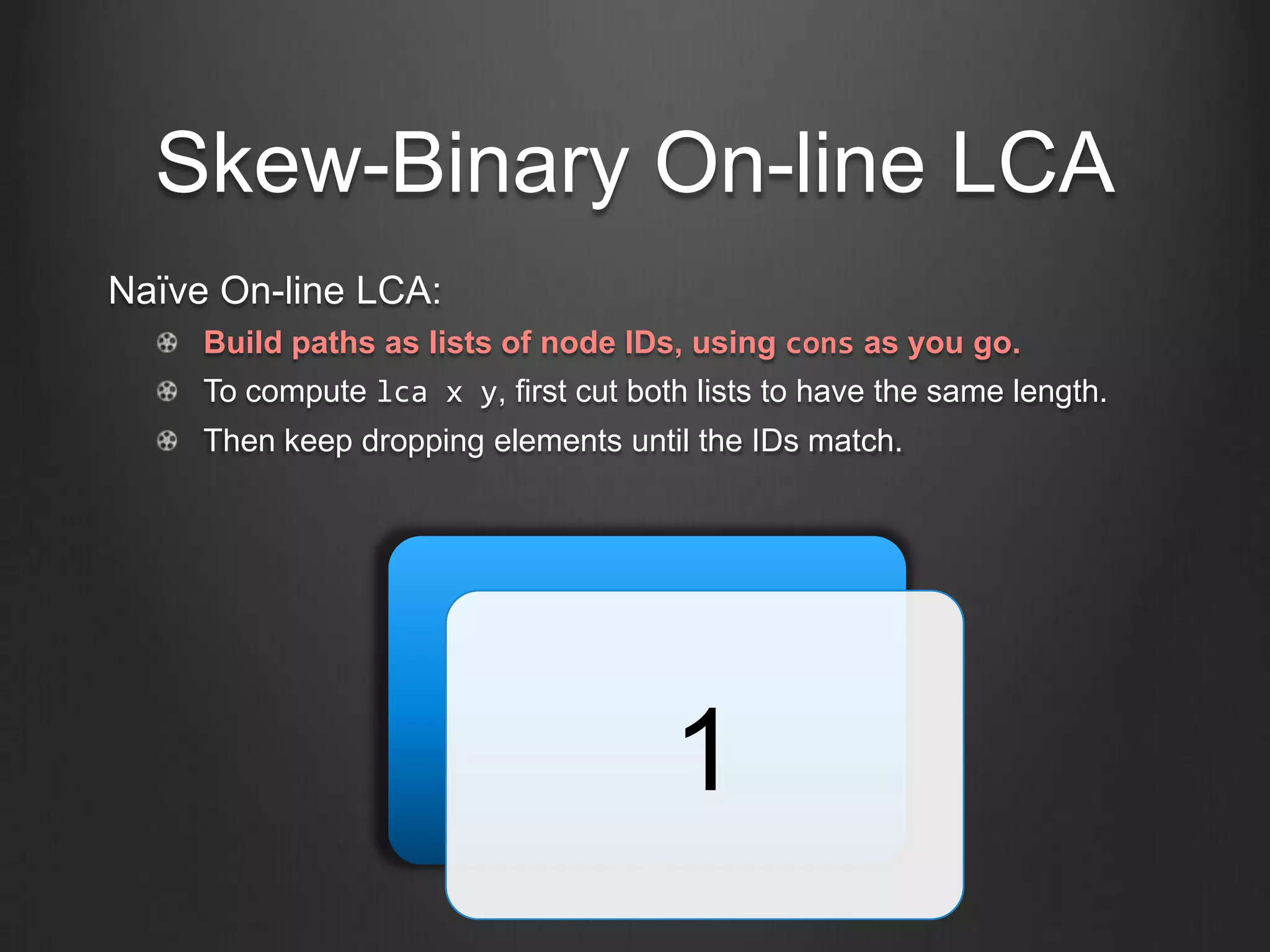
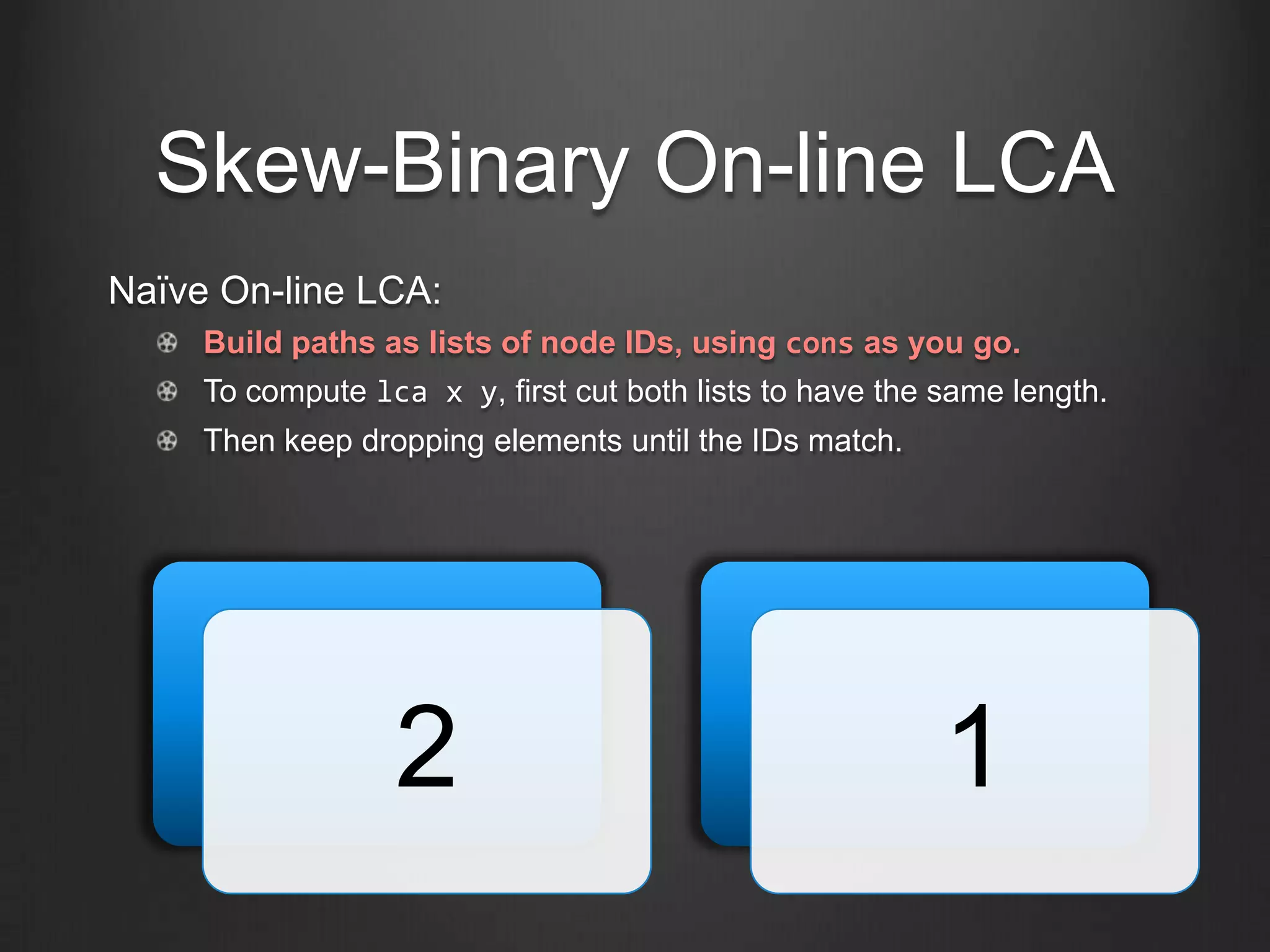
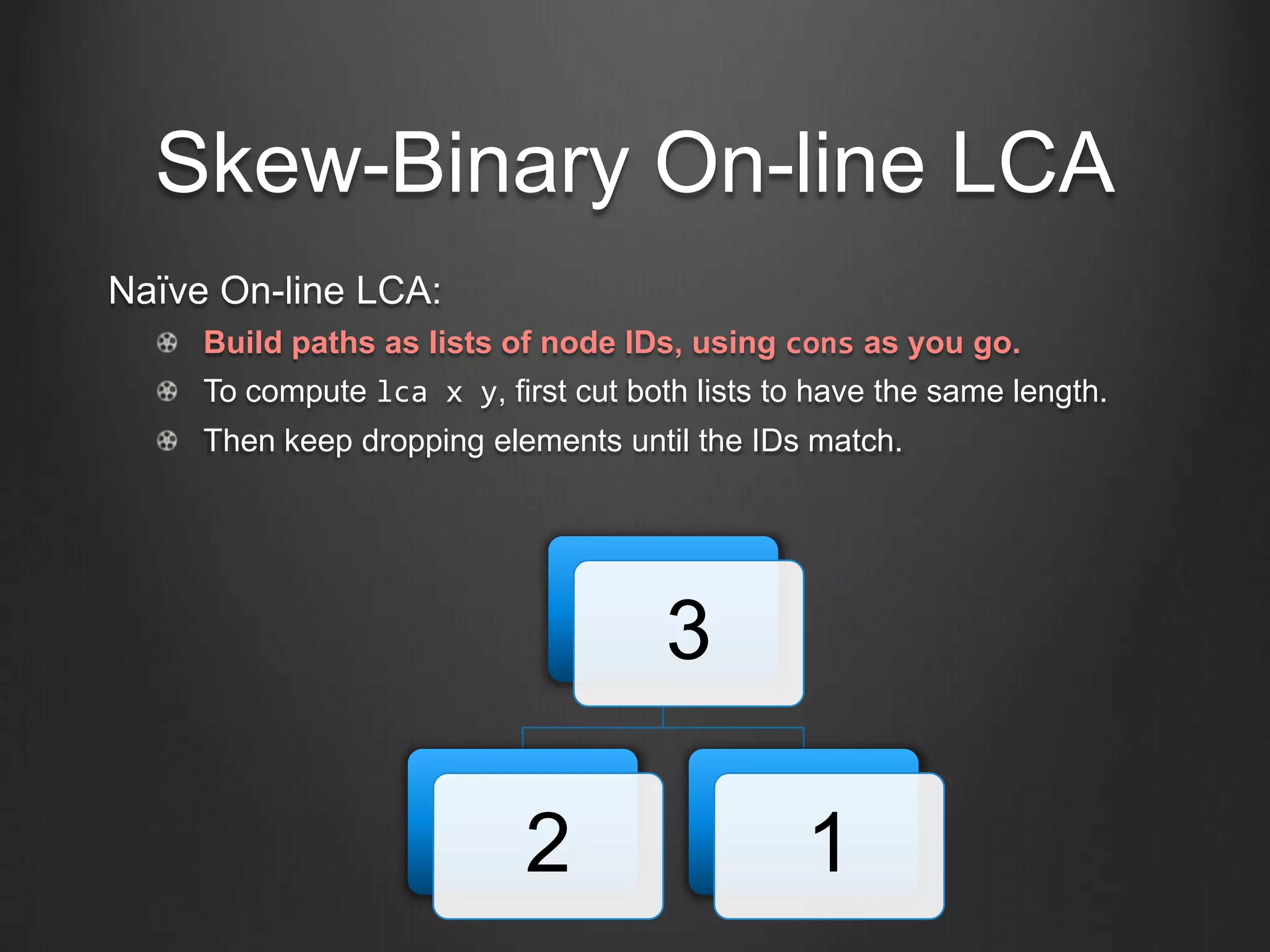
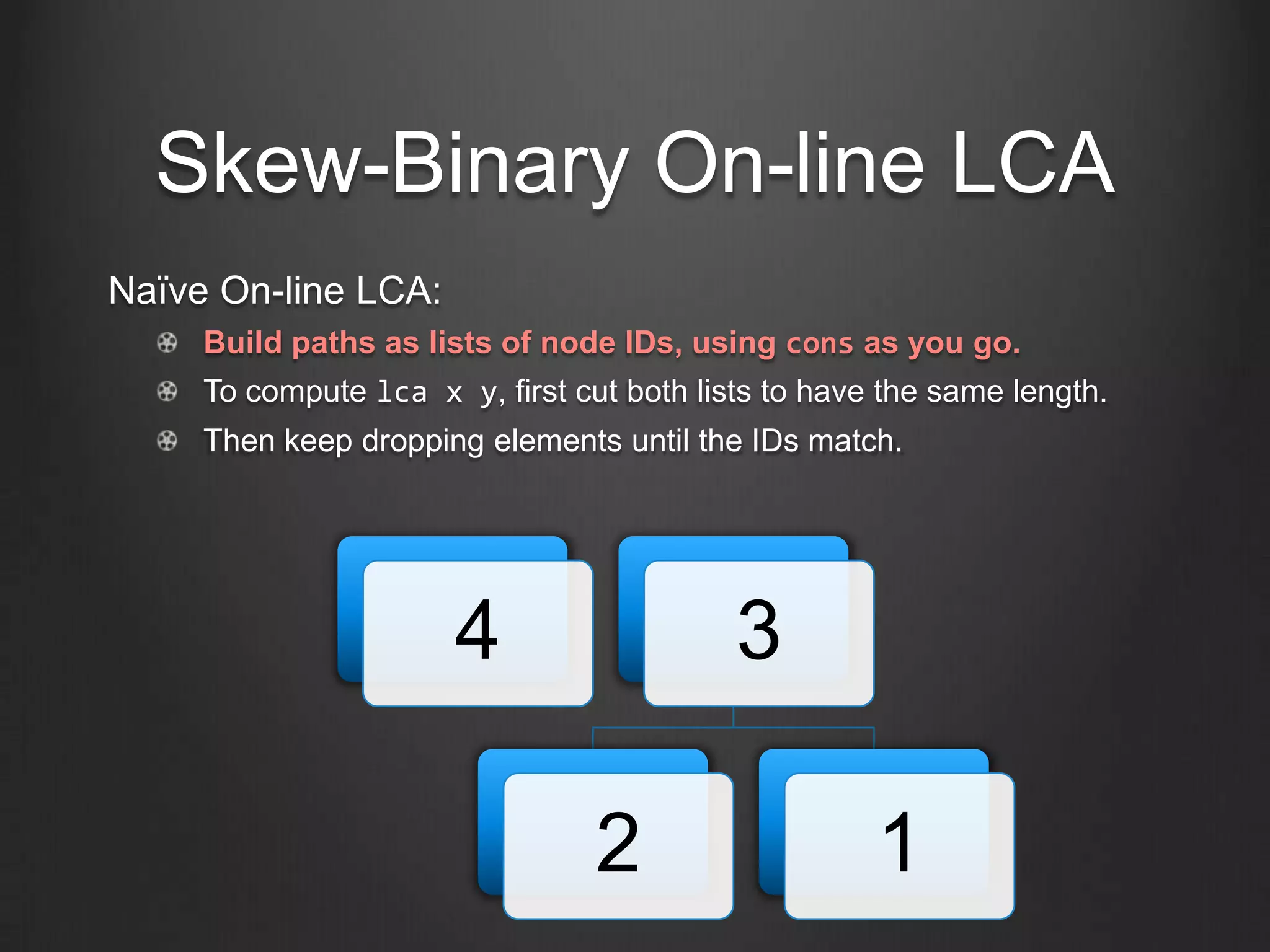
Naïve On-line LCA:
     Build paths as lists of node IDs, using cons as you go.
     To compute lca x y, first cut both lists to have the same length.
     Then keep dropping elements until the IDs match.
Slide 20 of 43 · ·
Skew-Binary On-line LCA
Naïve On-line LCA:
     Build paths as lists of node IDs, using cons as you go.
     To compute lca x y, first cut both lists to have the same length.
     Then keep dropping elements until the IDs match.
Slide 21 of 43 · ·
Skew-Binary On-line LCA
Naïve On-line LCA:
     Build paths as lists of node IDs, using cons as you go.
     To compute lca x y, first cut both lists to have the same length.
     Then keep dropping elements until the IDs match.


                                      1
Slide 22 of 43 · ·
Skew-Binary On-line LCA
Naïve On-line LCA:
     Build paths as lists of node IDs, using cons as you go.
     To compute lca x y, first cut both lists to have the same length.
     Then keep dropping elements until the IDs match.


                  2                                       1
Slide 23 of 43 · ·
Skew-Binary On-line LCA
Naïve On-line LCA:
     Build paths as lists of node IDs, using cons as you go.
     To compute lca x y, first cut both lists to have the same length.
     Then keep dropping elements until the IDs match.


                                      3

                            2                   1
Slide 24 of 43 · ·
Skew-Binary On-line LCA
Naïve On-line LCA:
     Build paths as lists of node IDs, using cons as you go.
     To compute lca x y, first cut both lists to have the same length.
     Then keep dropping elements until the IDs match.


                       4                   3

                                 2                   1
Slide 25 of 43 · ·
Skew-Binary On-line LCA
Naïve On-line LCA:
     Build paths as lists of node IDs, using cons as you go.
     To compute lca x y, first cut both lists to have the same length.
     Then keep dropping elements until the IDs match.


            5                    4                   3

                                           2                   1
Slide 26 of 43 · ·
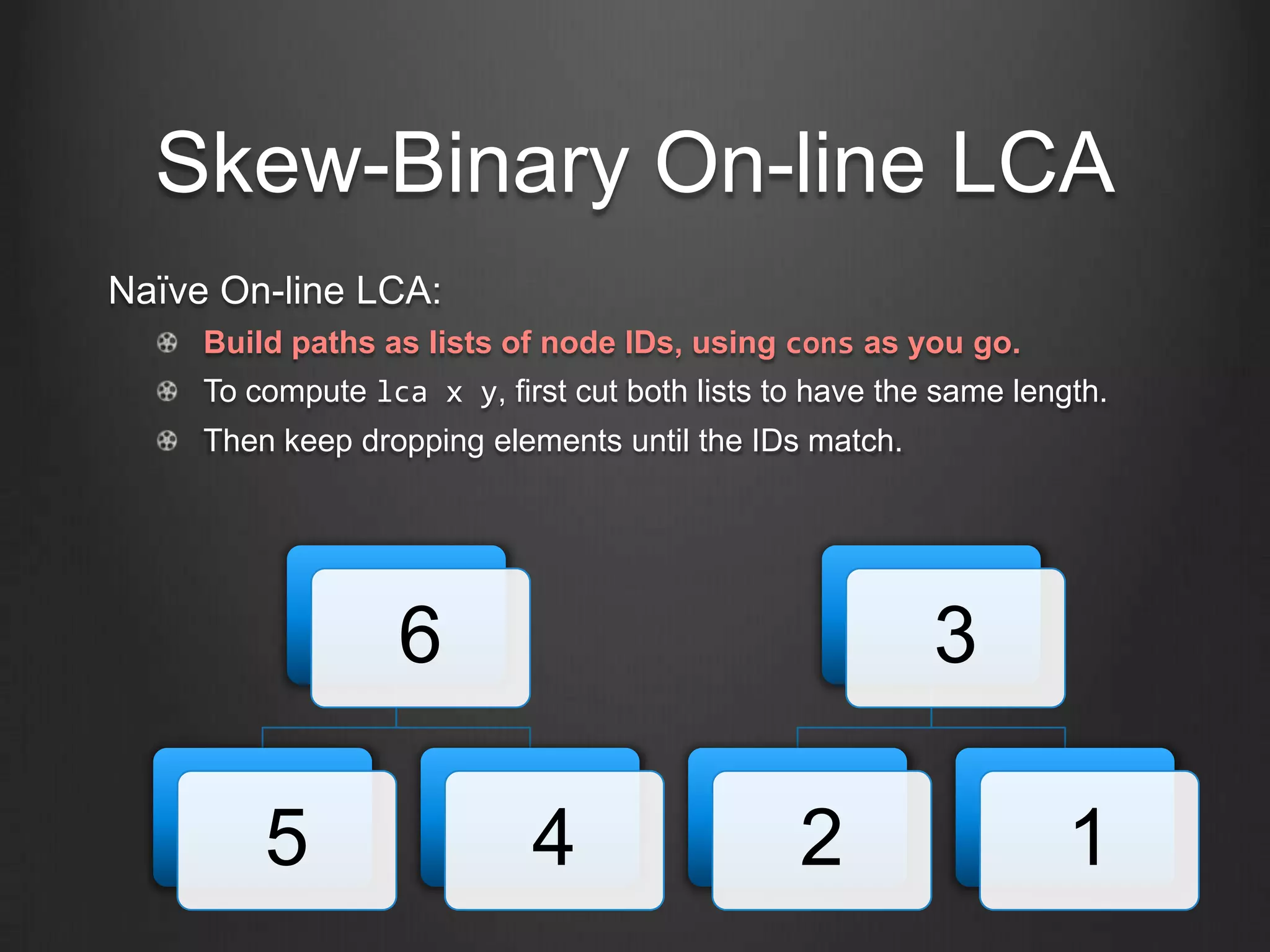
Skew-Binary On-line LCA
Naïve On-line LCA:
     Build paths as lists of node IDs, using cons as you go.
     To compute lca x y, first cut both lists to have the same length.
     Then keep dropping elements until the IDs match.


                   6                                     3

         5                  4                  2                   1
Slide 27 of 43 · ·
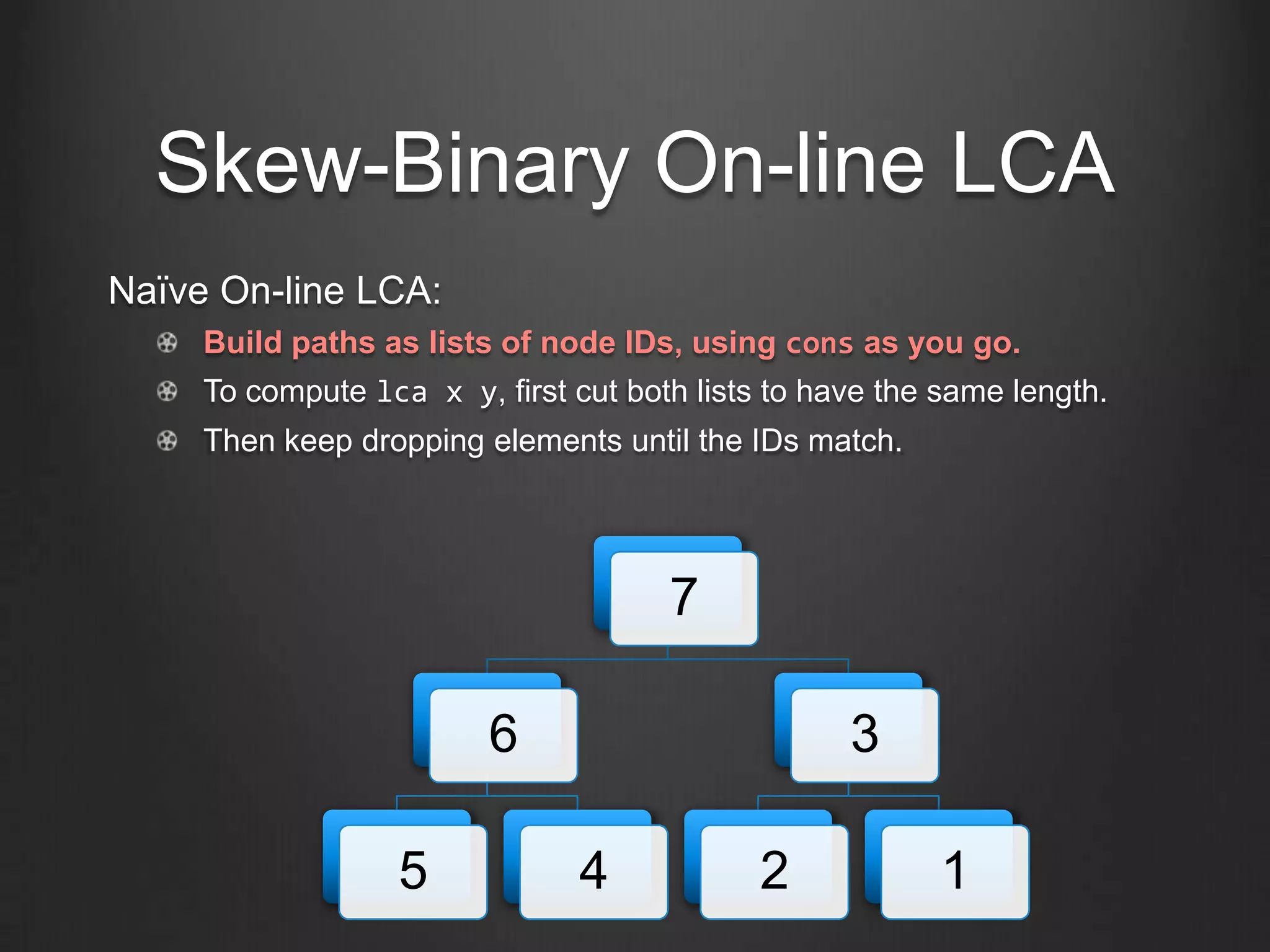
Skew-Binary On-line LCA
Naïve On-line LCA:
     Build paths as lists of node IDs, using cons as you go.
     To compute lca x y, first cut both lists to have the same length.
     Then keep dropping elements until the IDs match.


                                      7

                         6                         3

                   5            4            2           1
Slide 28 of 43 · ·
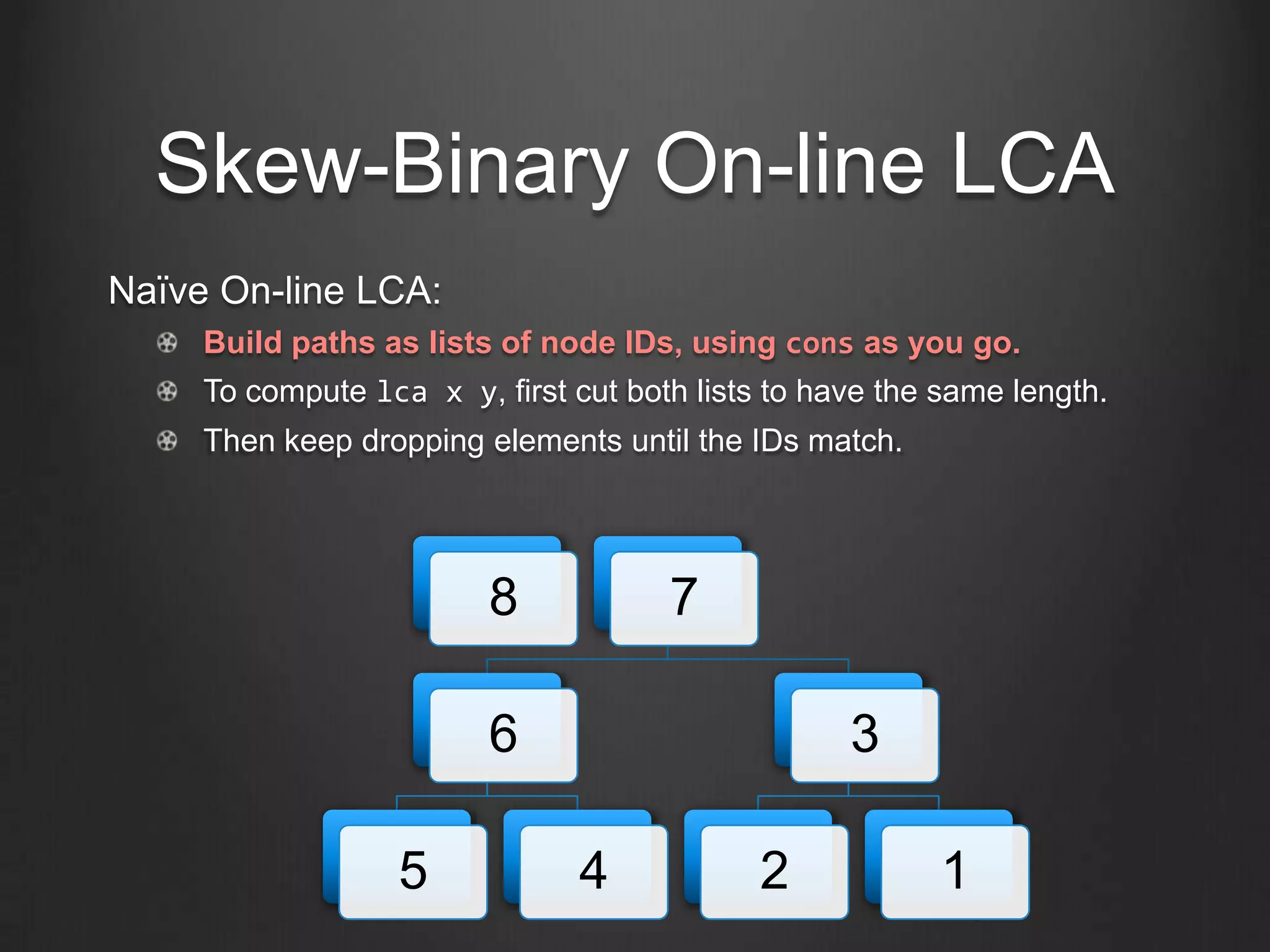
Skew-Binary On-line LCA
Naïve On-line LCA:
     Build paths as lists of node IDs, using cons as you go.
     To compute lca x y, first cut both lists to have the same length.
     Then keep dropping elements until the IDs match.


                         8            7

                         6                         3

                   5            4            2           1
Slide 29 of 43 · ·
Skew-Binary On-line LCA
Naïve On-line LCA:
     Build paths as lists of node IDs, using cons as you go.
     To compute lca x y, first cut both lists to have the same length.
     Then keep dropping elements until the IDs match.


-- O(1)
cons :: a -> Path a -> Path a
cons a (Cons n w t (Cons _ w' t2 ts))
  | w == w' = Cons (n + 1) (2 * w + 1) (Bin a t t2) ts
cons a ts = Cons (length ts + 1) 1 (Tip a) ts
Slide 30 of 43 · ·
Skew-Binary On-line LCA
Naïve On-line LCA:
     Build paths as lists of node IDs, using cons as you go.
     To compute lca x y, first cut both lists to have the same length.
     Then keep dropping elements until the IDs match.

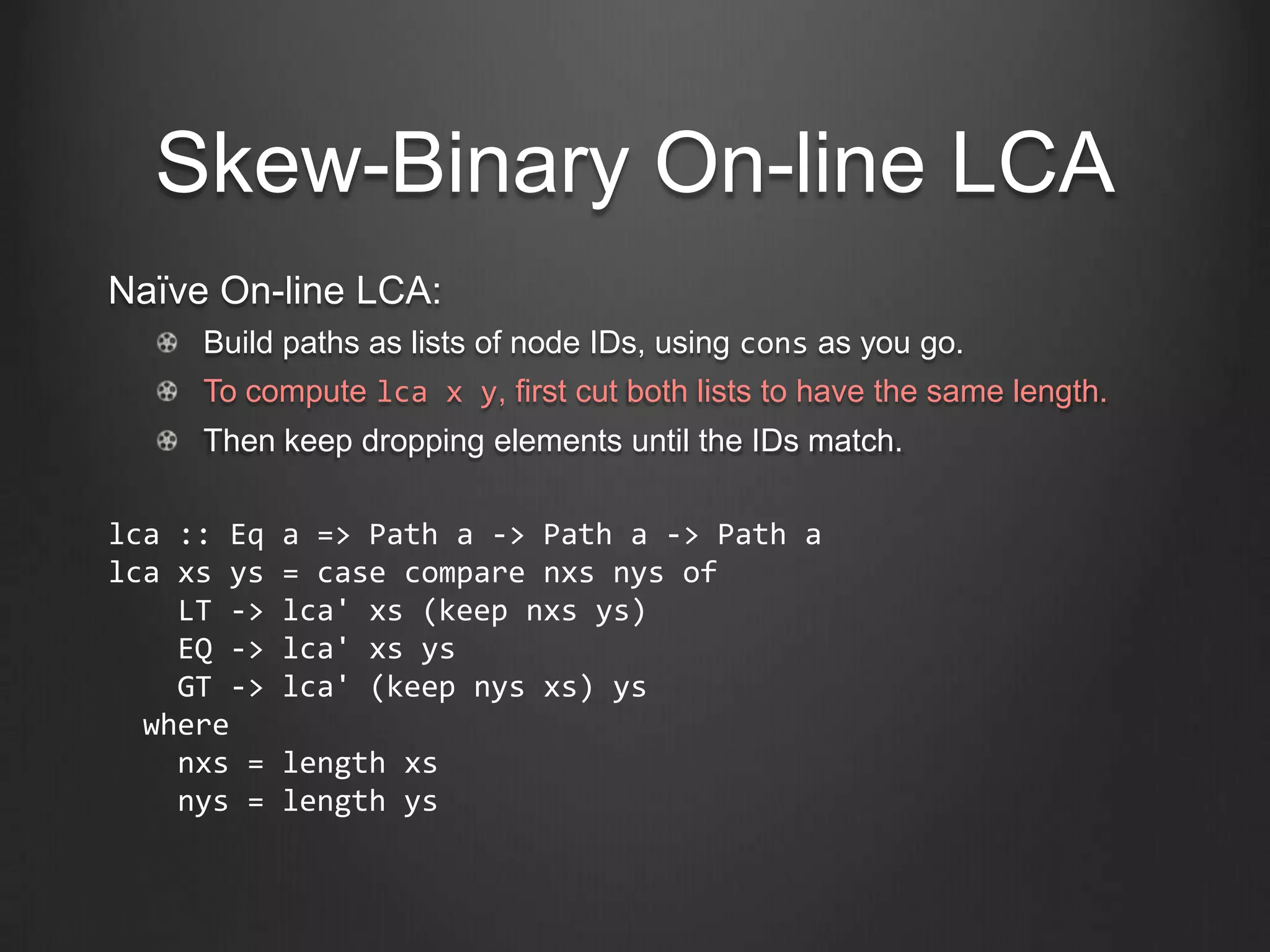
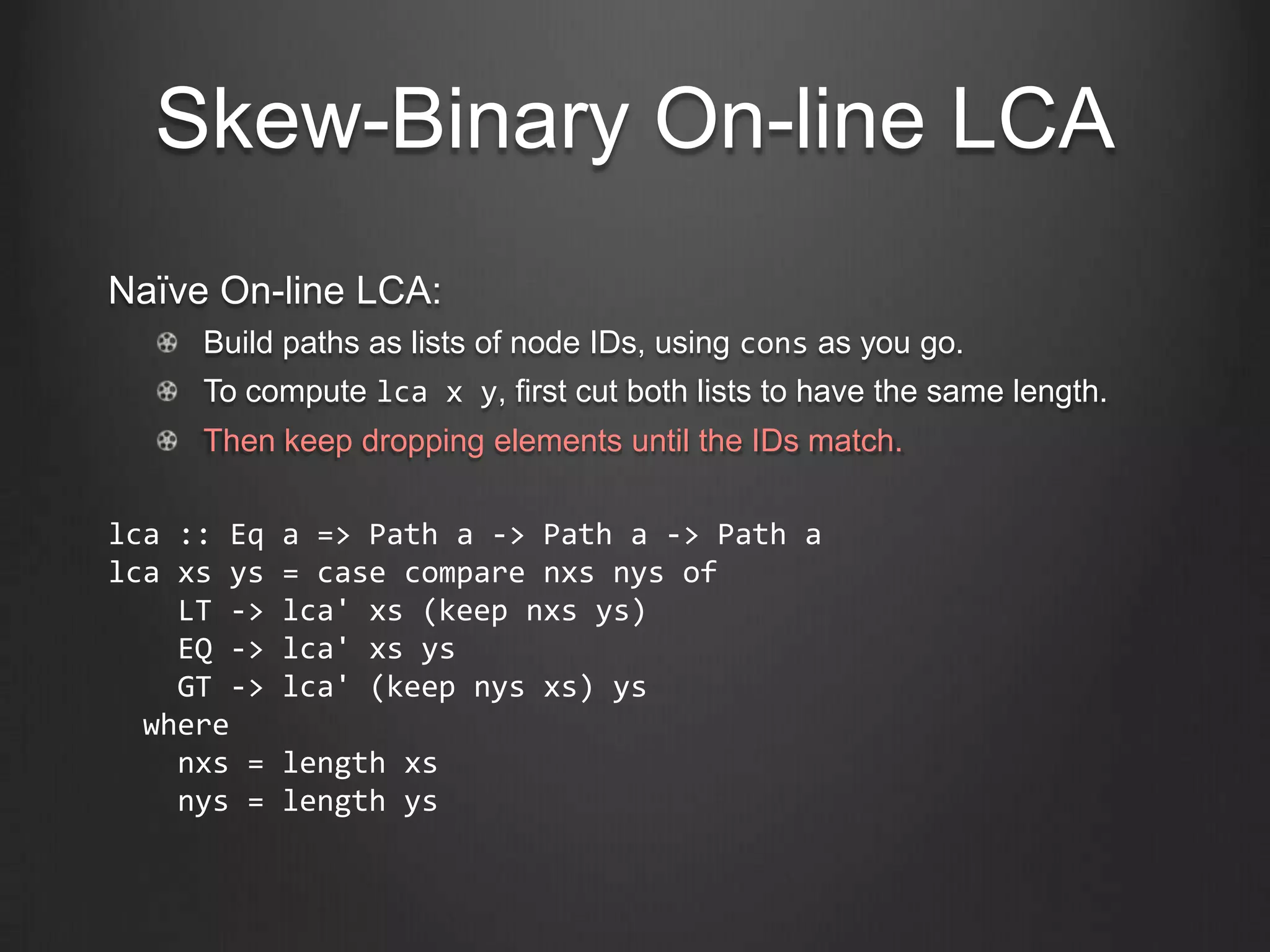
lca :: Eq   a => Path a -> Path a -> Path a
lca xs ys   = case compare nxs nys of
    LT ->   lca' xs (keep nxs ys)
    EQ ->   lca' xs ys
    GT ->   lca' (keep nys xs) ys
  where
    nxs =   length xs
    nys =   length ys
Slide 31 of 43 · ·
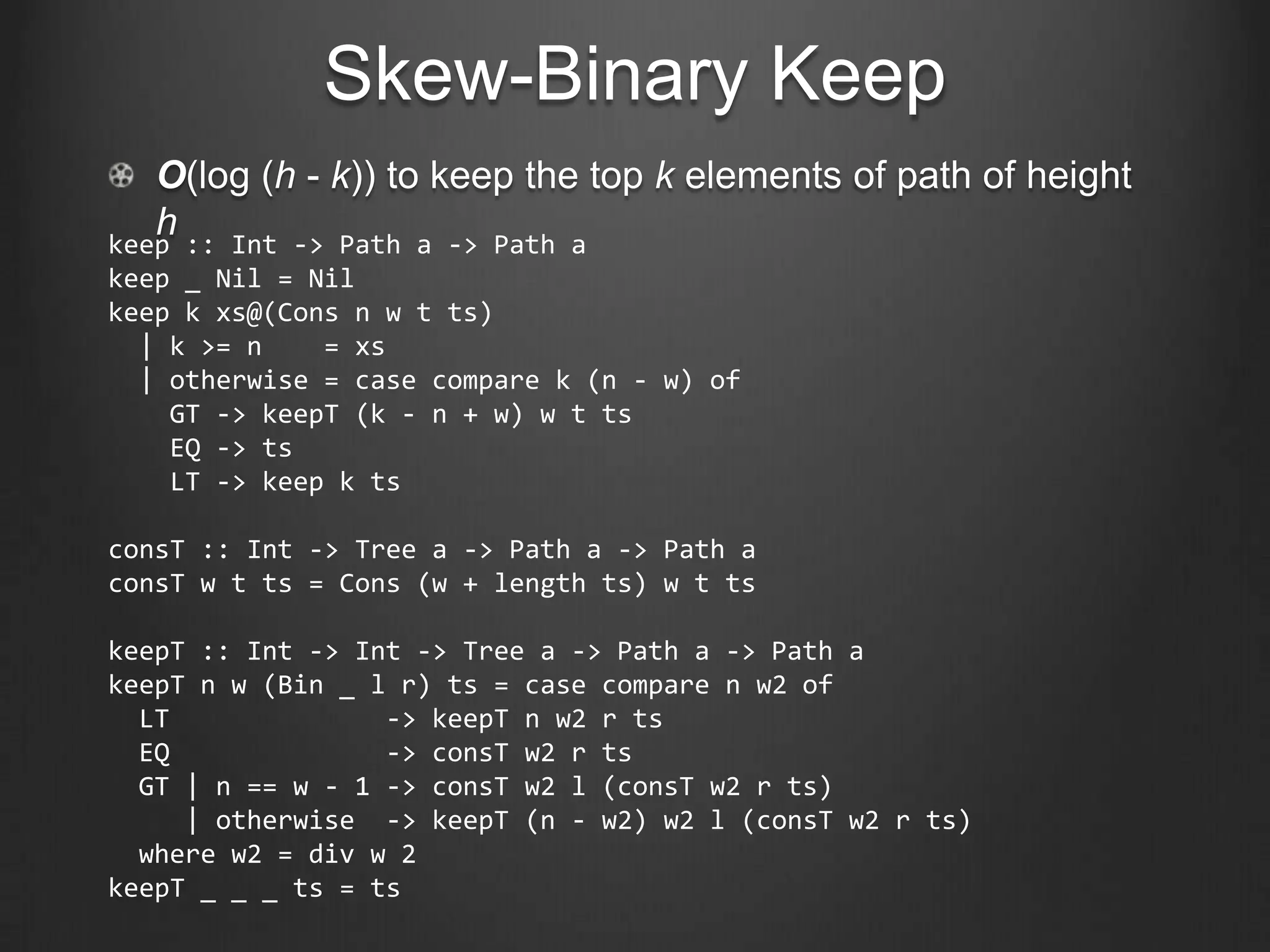
Skew-Binary Keep
O(log (h - k)) to keep the top k elements of path of height
h
            keep 2 (fromList [6,5,4,3,2,1])


              6                                3

      5               4               2                1
Slide 32 of 43 · ·
Skew-Binary Keep
O(log (h - k)) to keep the top k elements of path of height
h
            keep 2 (fromList [6,5,4,3,2,1])
                           =
               keep 2 (fromList [3,2,1])


              6                                3

      5               4               2                1
Slide 33 of 43 · ·
Skew-Binary Keep
O(log (h - k)) to keep the top k elements of path of height
h
            keep 2 (fromList [6,5,4,3,2,1])


              6                                3

      5               4               2                1
Slide 34 of 43 · ·
Skew-Binary Keep
   O(log (h - k)) to keep the top k elements of path of height
   h
keep :: Int -> Path a -> Path a
keep _ Nil = Nil
keep k xs@(Cons n w t ts)
  | k >= n    = xs
  | otherwise = case compare k (n - w) of
    GT -> keepT (k - n + w) w t ts
    EQ -> ts
    LT -> keep k ts

consT :: Int -> Tree a -> Path a -> Path a
consT w t ts = Cons (w + length ts) w t ts

keepT :: Int -> Int -> Tree a -> Path a -> Path a
keepT n w (Bin _ l r) ts = case compare n w2 of
  LT              -> keepT n w2 r ts
  EQ              -> consT w2 r ts
  GT | n == w - 1 -> consT w2 l (consT w2 r ts)
     | otherwise -> keepT (n - w2) w2 l (consT w2 r ts)
  where w2 = div w 2
keepT _ _ _ ts = ts
Slide 35 of 43 · ·
Skew-Binary On-line LCA
Naïve On-line LCA:
     Build paths as lists of node IDs, using cons as you go.
     To compute lca x y, first cut both lists to have the same length.
     Then keep dropping elements until the IDs match.

lca :: Eq   a => Path a -> Path a -> Path a
lca xs ys   = case compare nxs nys of
    LT ->   lca' xs (keep nxs ys)
    EQ ->   lca' xs ys
    GT ->   lca' (keep nys xs) ys
  where
    nxs =   length xs
    nys =   length ys
Slide 36 of 43 · ·
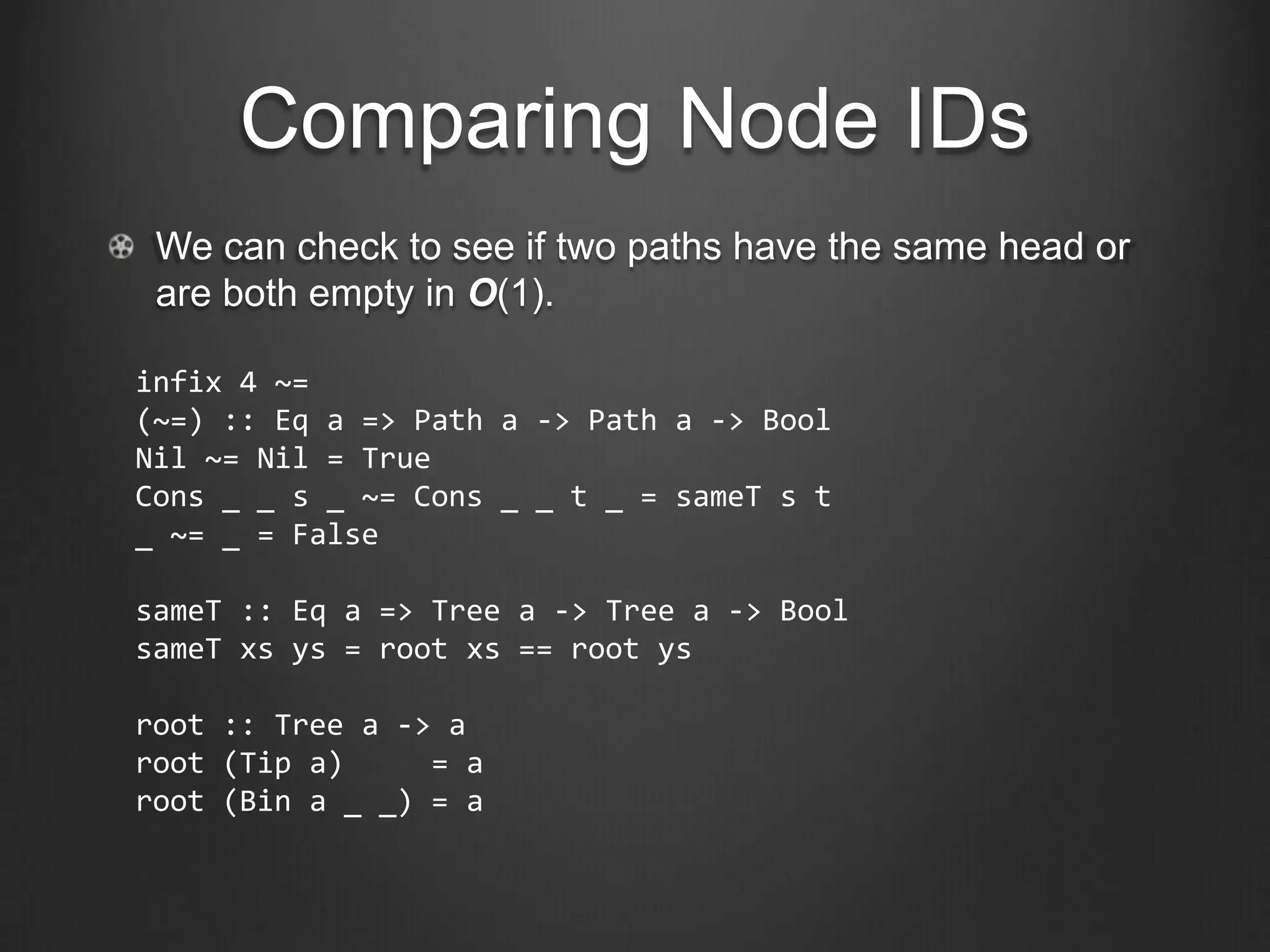
Comparing Node IDs
 We can check to see if two paths have the same head or
 are both empty in O(1).

infix 4 ~=
(~=) :: Eq a => Path a -> Path a -> Bool
Nil ~= Nil = True
Cons _ _ s _ ~= Cons _ _ t _ = sameT s t
_ ~= _ = False

sameT :: Eq a => Tree a -> Tree a -> Bool
sameT xs ys = root xs == root ys

root :: Tree a -> a
root (Tip a)     = a
root (Bin a _ _) = a
Slide 37 of 43 · ·
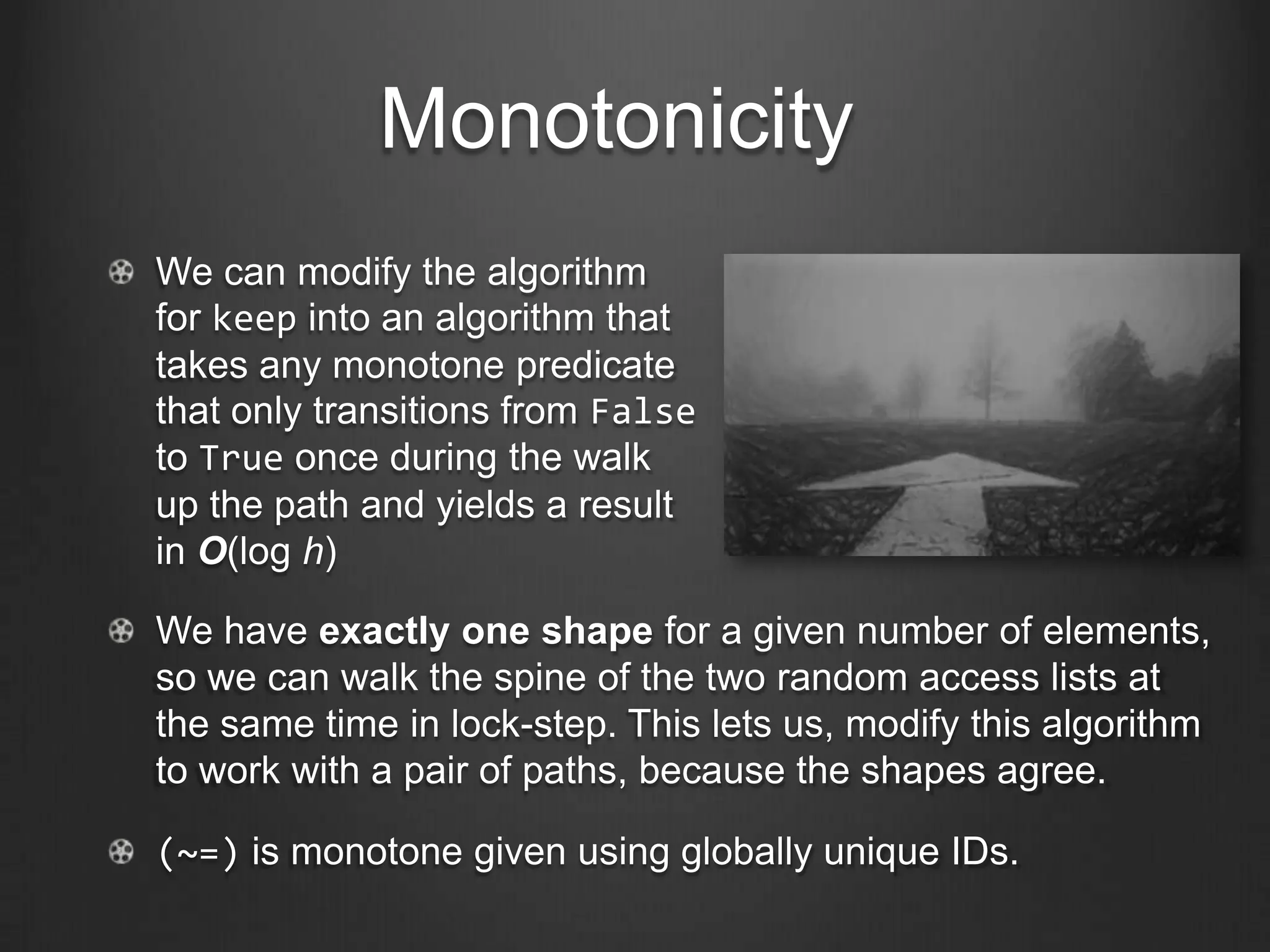
Monotonicity
We can modify the algorithm
for keep into an algorithm that
takes any monotone predicate
that only transitions from False
to True once during the walk
up the path and yields a result
in O(log h)

We have exactly one shape for a given number of elements,
so we can walk the spine of the two random access lists at
the same time in lock-step. This lets us, modify this algorithm
to work with a pair of paths, because the shapes agree.

(~=) is monotone given using globally unique IDs.
Slide 38 of 43 · ·
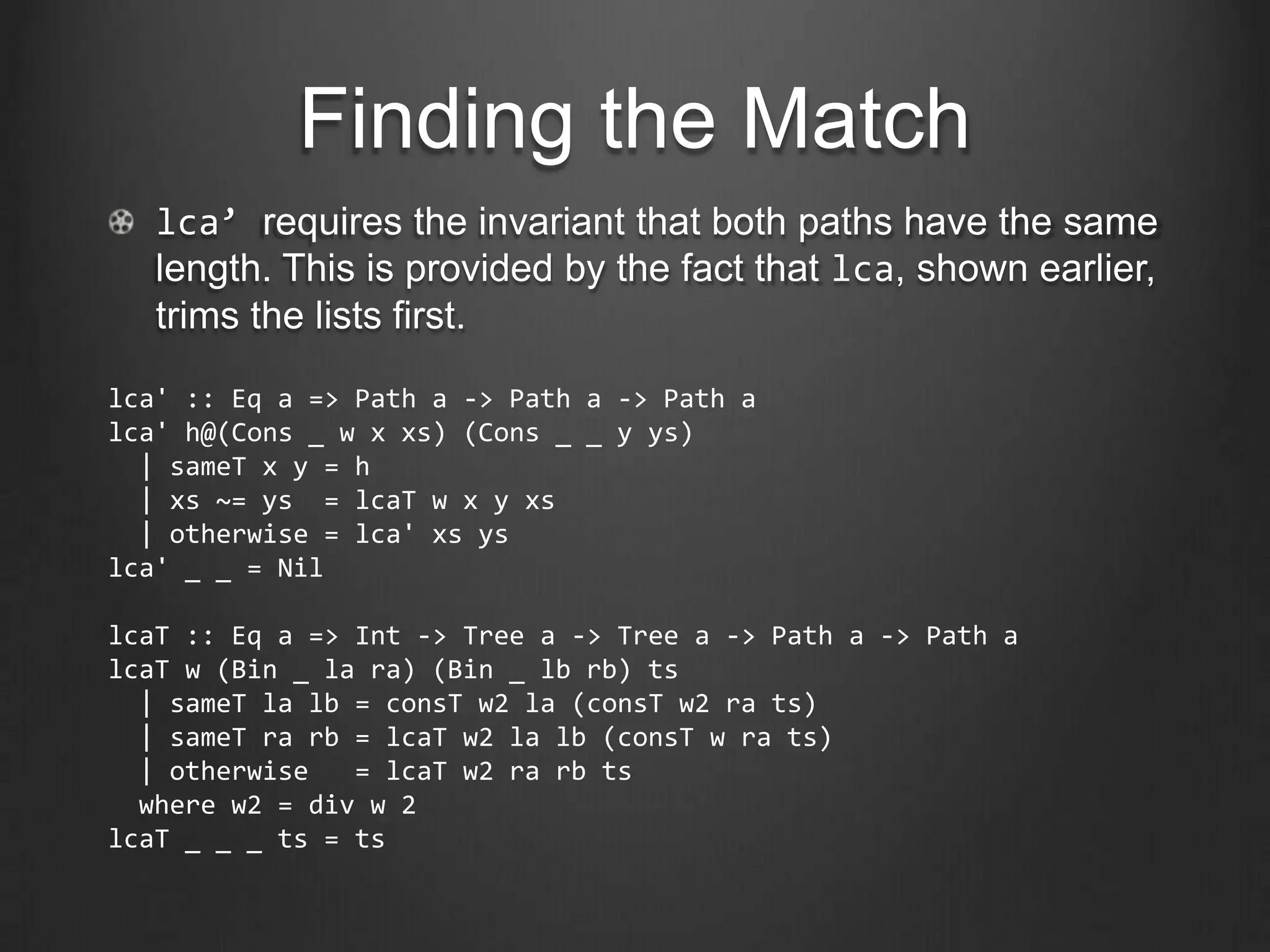
Finding the Match
   lca’ requires the invariant that both paths have the same
   length. This is provided by the fact that lca, shown earlier,
   trims the lists first.

lca' :: Eq a => Path a -> Path a -> Path a
lca' h@(Cons _ w x xs) (Cons _ _ y ys)
  | sameT x y = h
  | xs ~= ys = lcaT w x y xs
  | otherwise = lca' xs ys
lca' _ _ = Nil

lcaT :: Eq a => Int -> Tree a -> Tree a -> Path a -> Path a
lcaT w (Bin _ la ra) (Bin _ lb rb) ts
  | sameT la lb = consT w2 la (consT w2 ra ts)
  | sameT ra rb = lcaT w2 la lb (consT w ra ts)
  | otherwise   = lcaT w2 ra rb ts
  where w2 = div w 2
lcaT _ _ _ ts = ts
Slide 39 of 43 · ·
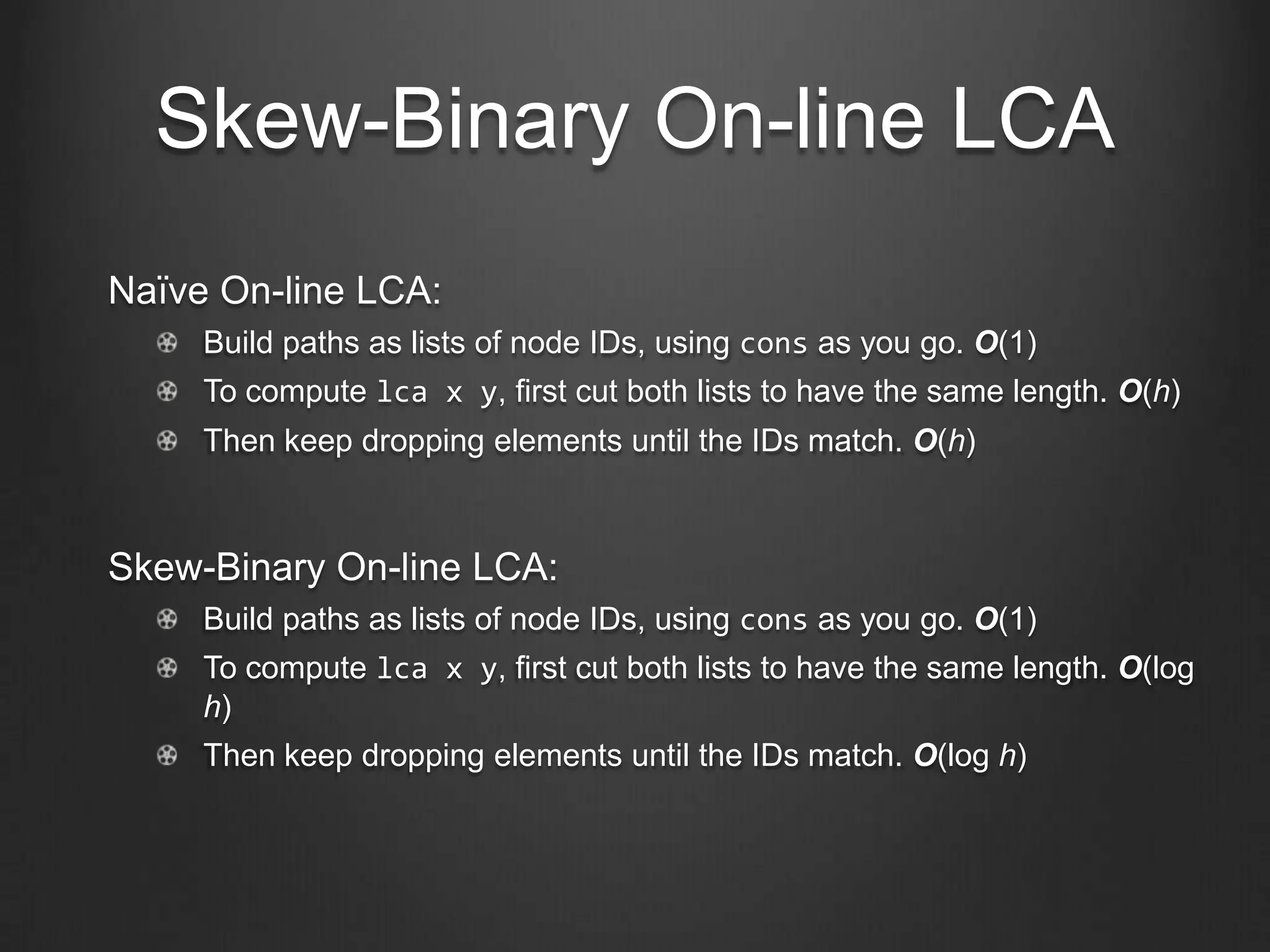
Skew-Binary On-line LCA
Naïve On-line LCA:
     Build paths as lists of node IDs, using cons as you go. O(1)
     To compute lca x y, first cut both lists to have the same length. O(h)
     Then keep dropping elements until the IDs match. O(h)


Skew-Binary On-line LCA:
     Build paths as lists of node IDs, using cons as you go. O(1)
     To compute lca x y, first cut both lists to have the same length. O(log
     h)
     Then keep dropping elements until the IDs match. O(log h)
Slide 40 of 43 · ·
Skew-Binary On-line LCA
No preprocessing step.

O(log h) LCA query time where h is the length of the path.

O(1) to extend a path.

No need to store the entire tree, just the paths you are currently
using. This helps with distribution and parallelization when
working on large trees.

As an on-line algorithm, the tree can grow without requiring
costly recalculations.

Preserves all of the benefits of the naïve algorithm, while
drastically reducing the costs.
Slide 41 of 43 · ·
Now What?
We found that skew-binary random access lists can be used to
accelerate the naïve online LCA algorithm while retaining the
desirable properties.

You can install a working version of this algorithm from hackage

                     cabal install lca

Next time I’ll talk about the applications of this algorithm to a
“revision control” monad which can be used for parallel and
incremental computation in Haskell.

I am working with Daniel Peebles on a proof of correctness and
asymptotic performance in Agda.
Slide 42 of 43 · ·
Any Questions?
Slide 43 of 43 ·