The Comonad.Readertypes, (co)monads, substructural logic

Making de Bruijn Succ Less

Edward Kmett

A presentation on variable binding, de Bruijn indices, and the approach used by the bound library.

Related article: Bound.

50 slides · Start reading
Making de Bruijn Succ Less


                             Edward Kmett
Slide 1 of 50 ·
   We use names in lots of contexts, but any
    program that deals with names has to deal
    with a number of issues such as

     capture avoidance
     deciding alpha equivalence


    … and others that will come up as we go.
Slide 2 of 50 · ·
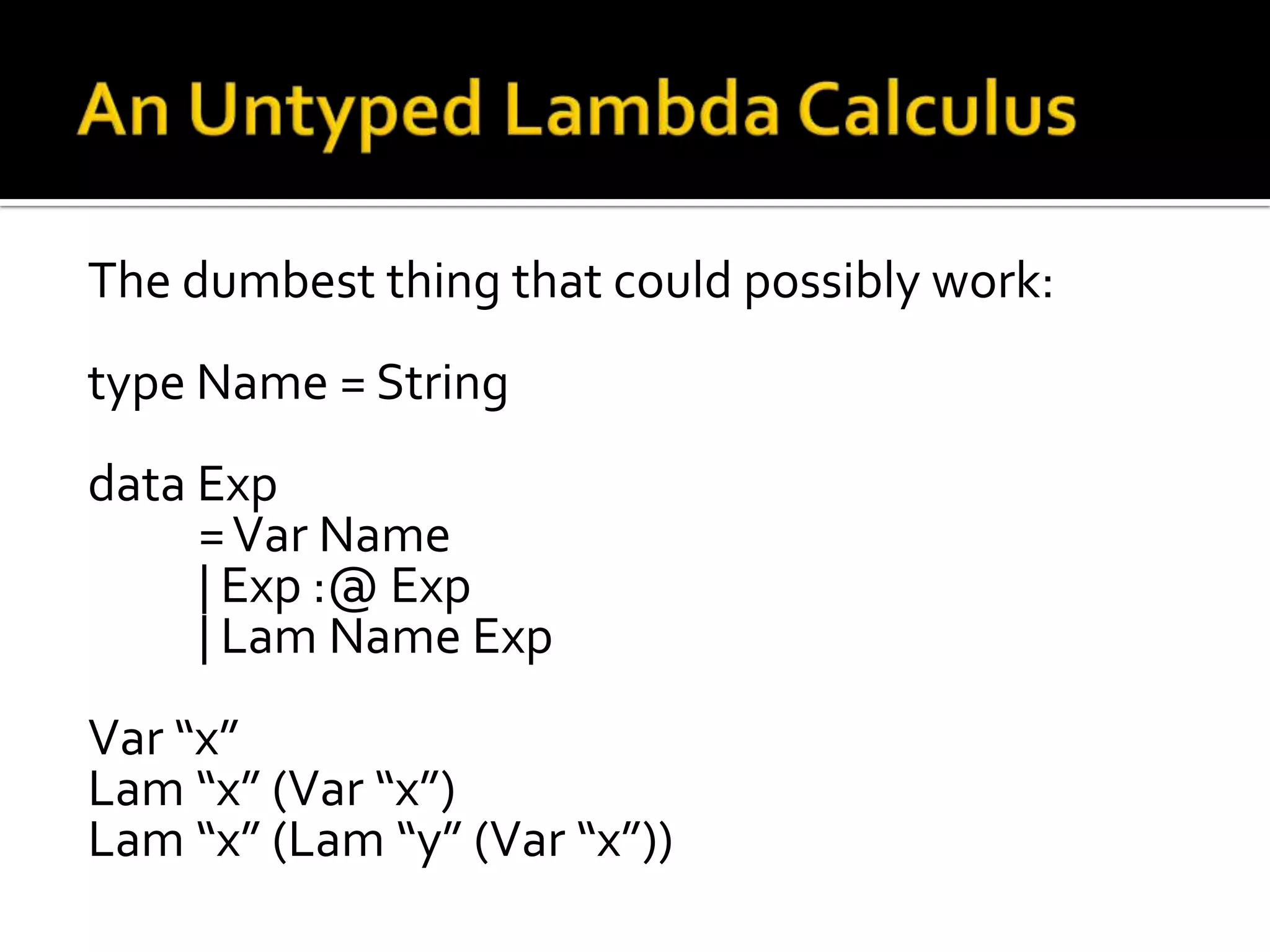
The dumbest thing that could possibly work:
type Name = String
data Exp
     = Var Name
     | Exp :@ Exp
     | Lam Name Exp
Var “x”
Lam “x” (Var “x”)
Lam “x” (Lam “y” (Var “x”))
Slide 3 of 50 · ·
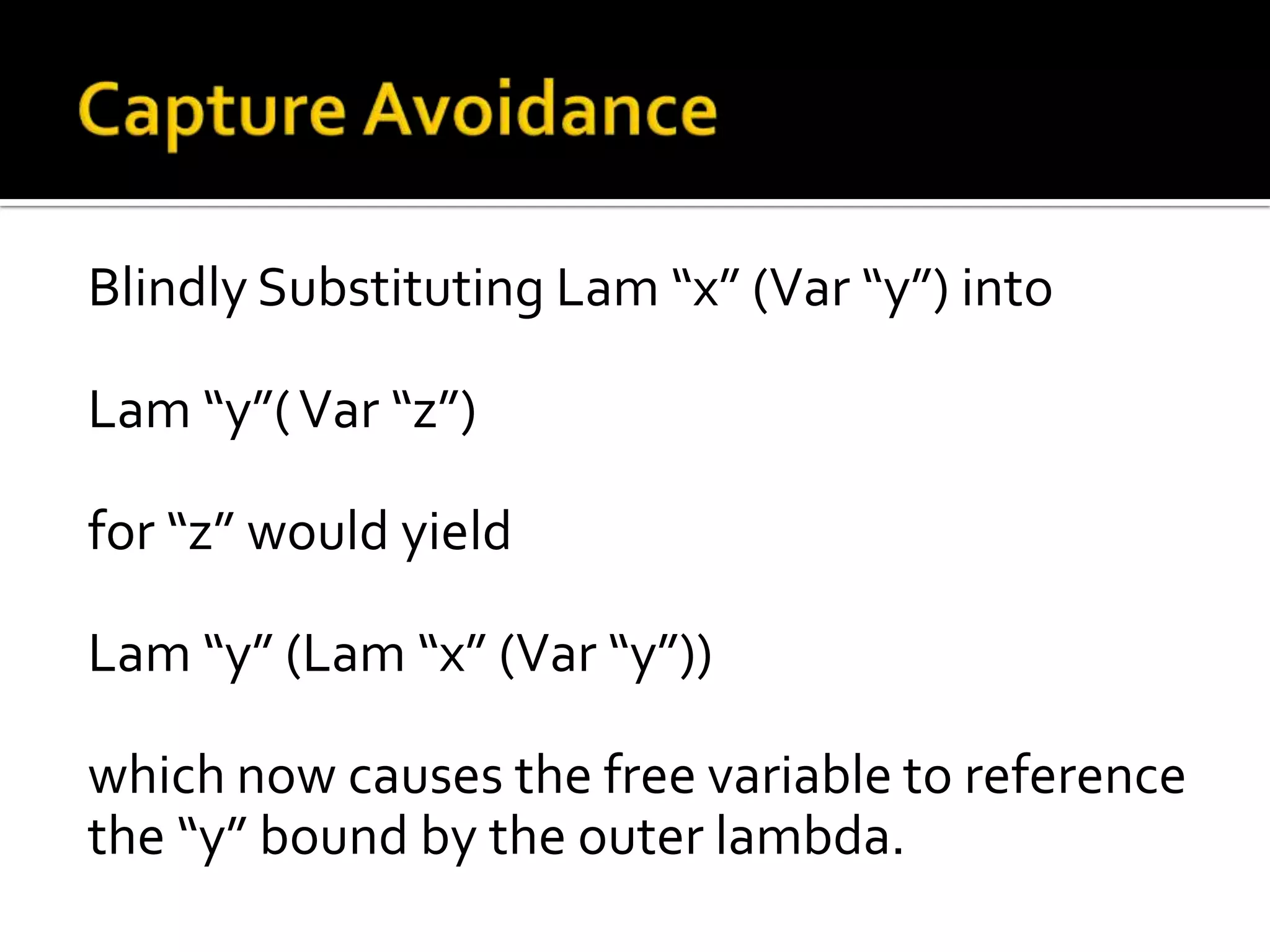
Blindly Substituting Lam “x” (Var “y”) into

Lam “y”( Var “z”)

for “z” would yield

Lam “y” (Lam “x” (Var “y”))

which now causes the free variable to reference
the “y” bound by the outer lambda.
Slide 4 of 50 · ·
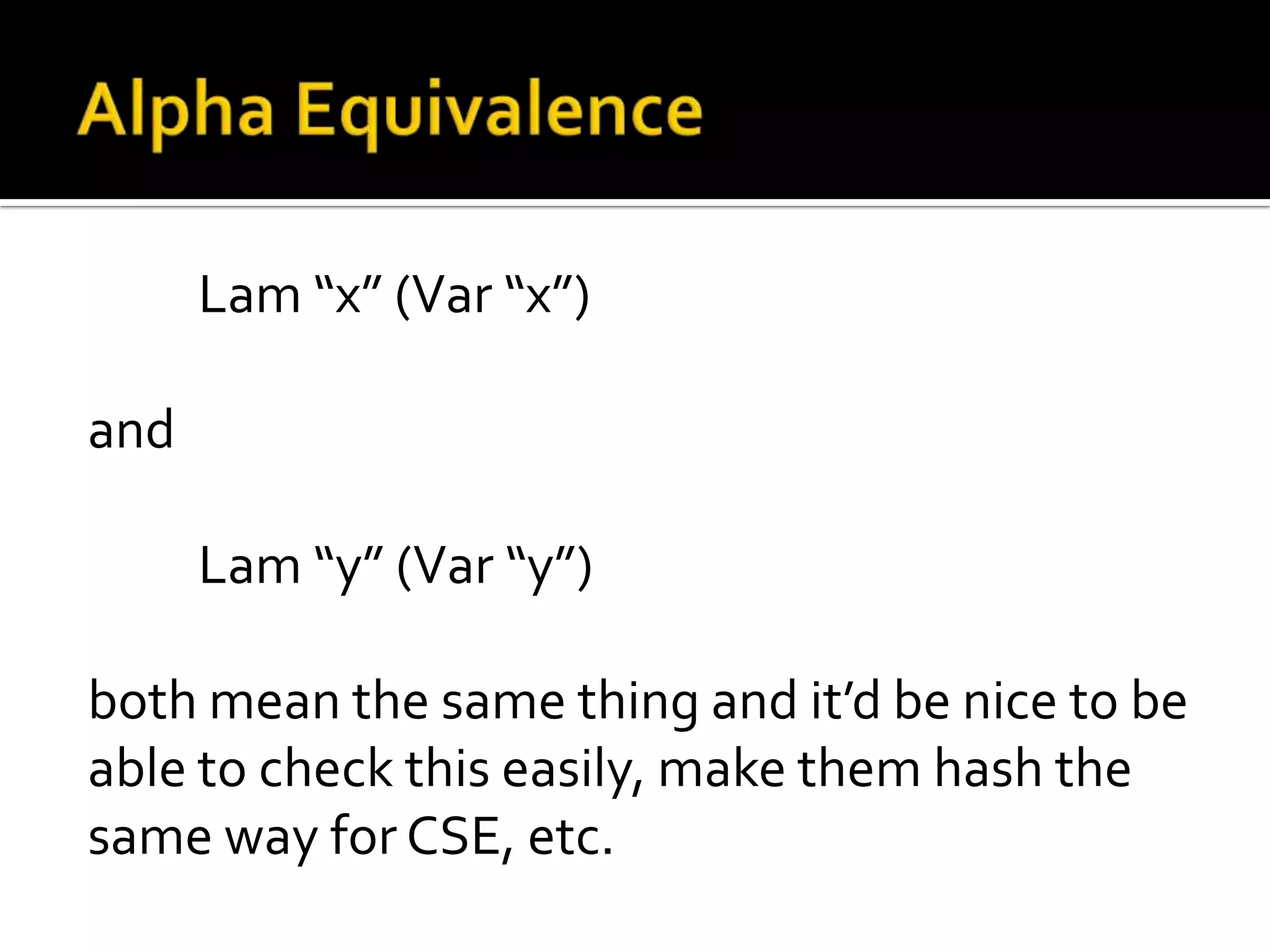
Lam “x” (Var “x”)

and

      Lam “y” (Var “y”)

both mean the same thing and it’d be nice to be
able to check this easily, make them hash the
same way for CSE, etc.
Slide 5 of 50 · ·
There is a cottage industry of solutions ot the naming
problem.
   Naïve substitution
   Barendregt Convention
   HOAS
   Weak HOAS / PHOAS
   “I am not a Number: I am a Free Variable!”
   Locally Nameless Syntax with de Bruijn Indices
   Unbound, mixing Barendregt and Locally Nameless.
   etc.
I will not be addressing all of these here, just a few.
Slide 6 of 50 · ·
Just go look for names that avoid capture.

Pros:
        Pretty syntax trees
        Easy to get started with

Cons:
     Easy even for experts to make mistakes!
     Alpha Equivalence checking is tedious.
     REALLY SLOW
Slide 7 of 50 · ·
subst :: Name -> Exp -> Exp -> Exp
subst x s = sub where
 sub e@(Var v)
          | v == x = s
          | otherwise = e
 sub e@(Lam v e')
          | v == x = e
          | v `elem` fvs = Lam v' (sub e'’)
          | otherwise = Lam v (sub e’)
          where v' = newId vs
                      e'' = subst v (Var v') e’
 sub (f :@ a) = sub f :@ sub a
 fvs = freeVars s
 vs = fvs `union` allVars b
newId :: [Name] -> Name
newId vs = head (someEnormousPoolOfNames  vs)
– go find a name that isn’t taken!
(based on code by Lennart Augustsson)
Slide 8 of 50 · ·
Make sure that every binder binds a globally unique name.

Pros:
 “Secrets of the GHC Inliner” describes ‘the Rapier’ which can make
 this Fast.

Cons:
 Easy even for experts to screw up
 Alpha Equivalence is tedious
 Need a globally unique variable supply (e.g. my concurrent-supply)
 The obvious implementation technique chews through a
     scarily large number of variable IDs.
Slide 9 of 50 · ·
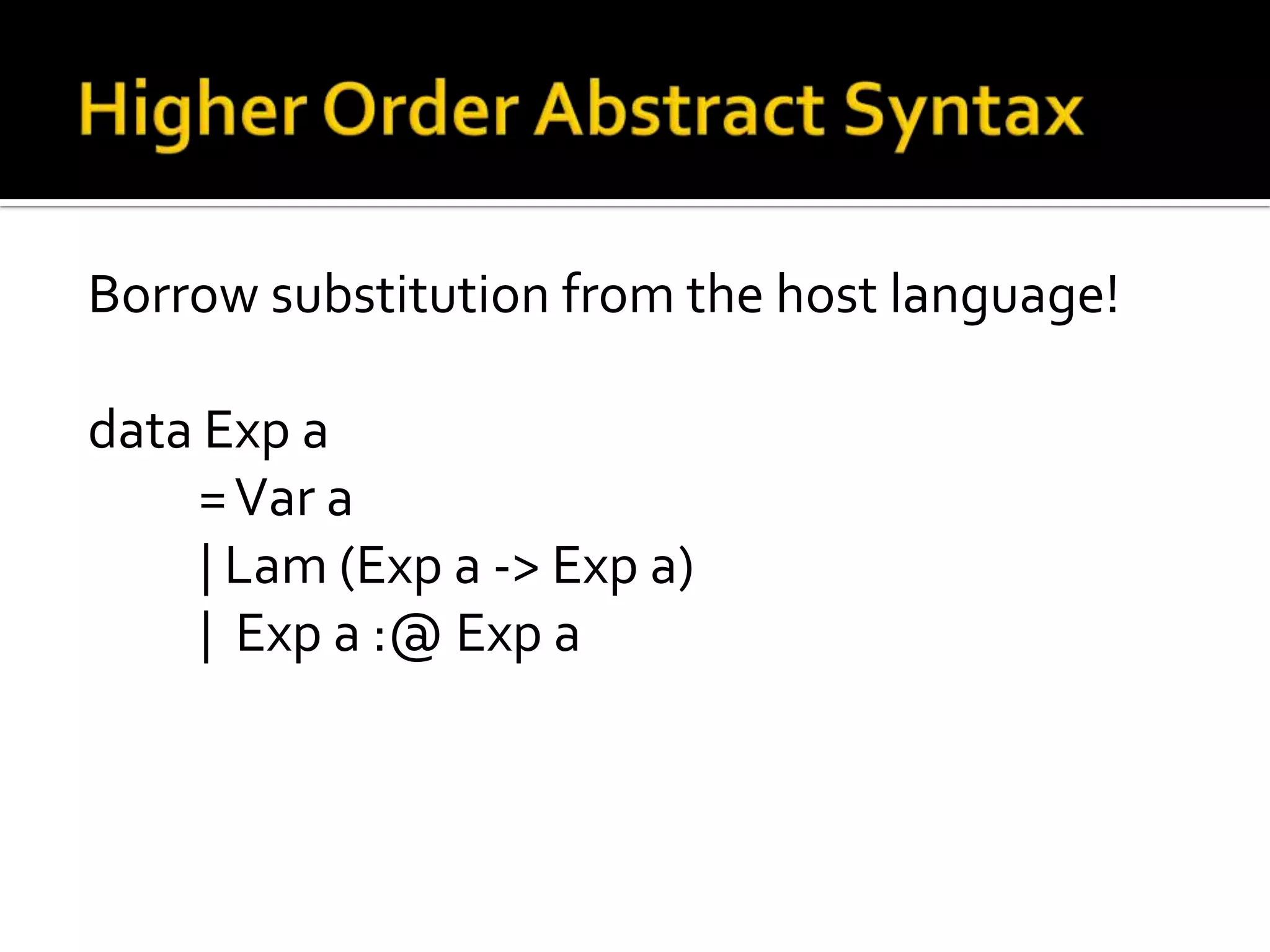
Borrow substitution from the host language!

data Exp a
    = Var a
     | Lam (Exp a -> Exp a)
     | Exp a :@ Exp a
Slide 10 of 50 · ·
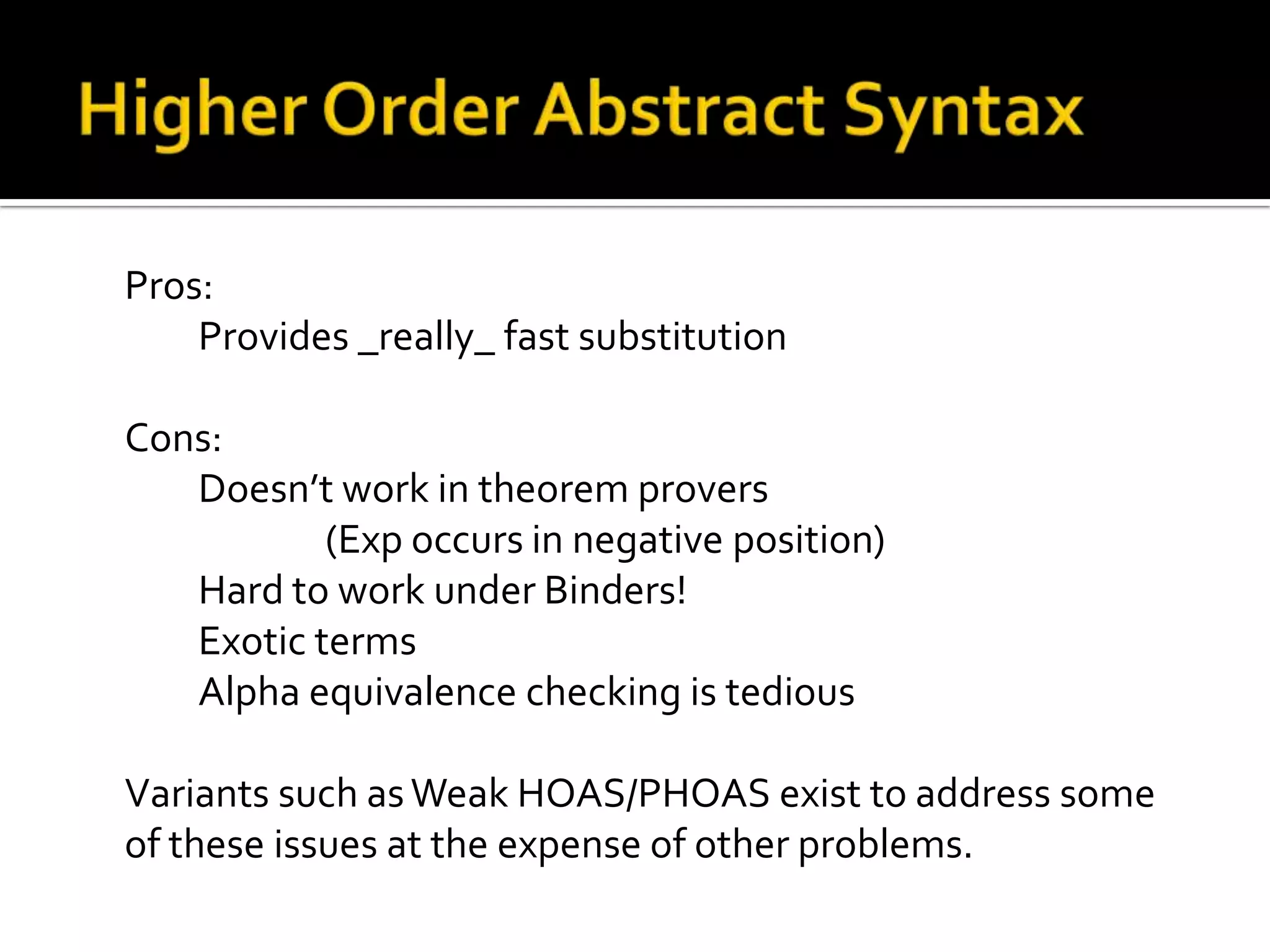
Pros:
    Provides _really_ fast substitution

Cons:
   Doesn’t work in theorem provers
           (Exp occurs in negative position)
   Hard to work under Binders!
   Exotic terms
   Alpha equivalence checking is tedious

Variants such as Weak HOAS/PHOAS exist to address some
of these issues at the expense of other problems.
Slide 11 of 50 · ·
M’colleague Bob Atkey once memorably described the
capacity to put up with de Bruijn indices as a Cylon
detector, the kind of reverse Turing Test that the humans in
Battlestar Galactica invent, the better to recognize one
another by their common inadequacies. He had a point.


                             —Conor McBride
       “I am not a number, I am a classy hack”
Slide 12 of 50 · ·
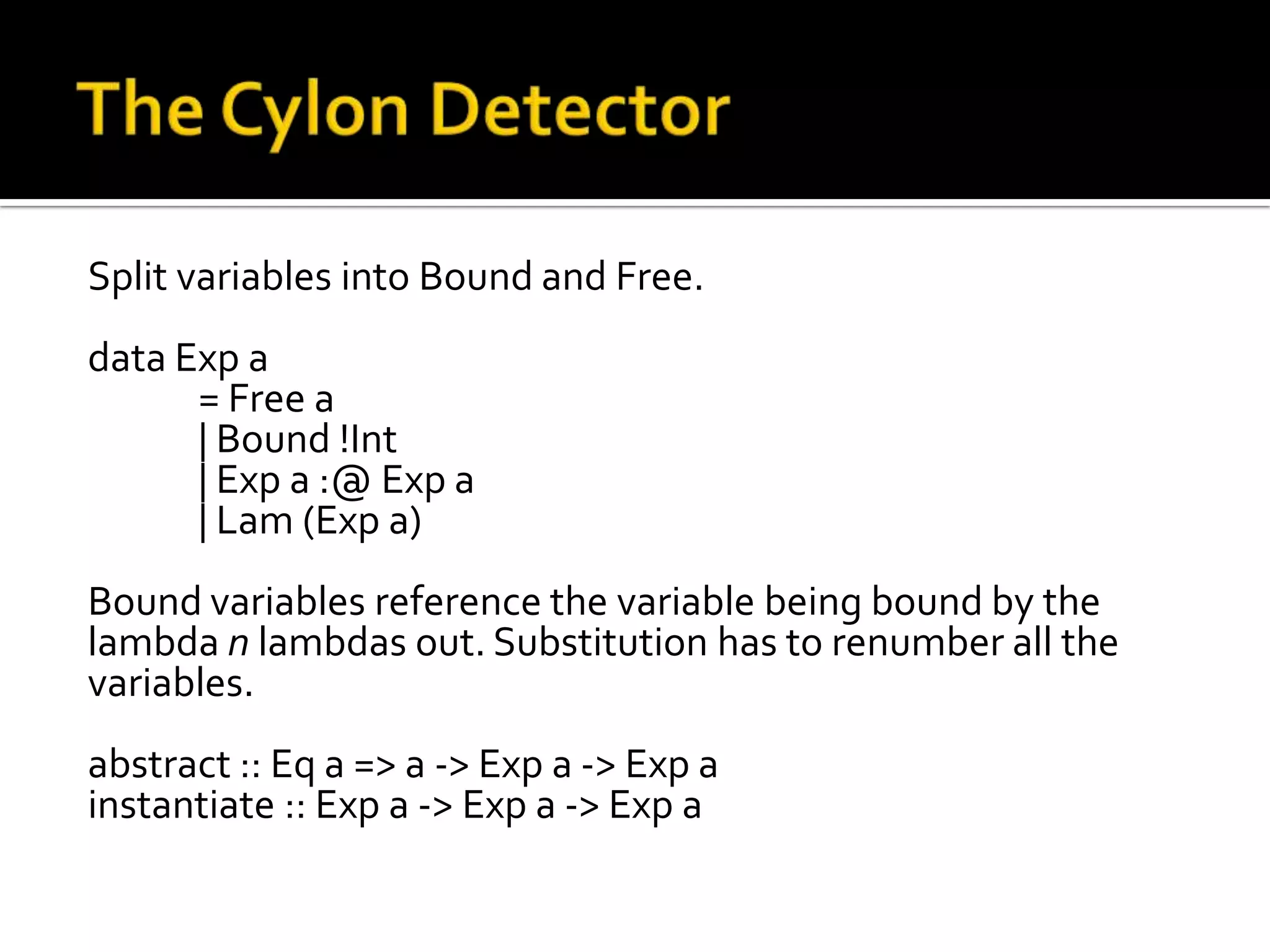
Split variables into Bound and Free.
data Exp a
      = Free a
      | Bound !Int
      | Exp a :@ Exp a
      | Lam (Exp a)
Bound variables reference the variable being bound by the
lambda n lambdas out. Substitution has to renumber all the
variables.
abstract :: Eq a => a -> Exp a -> Exp a
instantiate :: Exp a -> Exp a -> Exp a
Slide 13 of 50 · ·
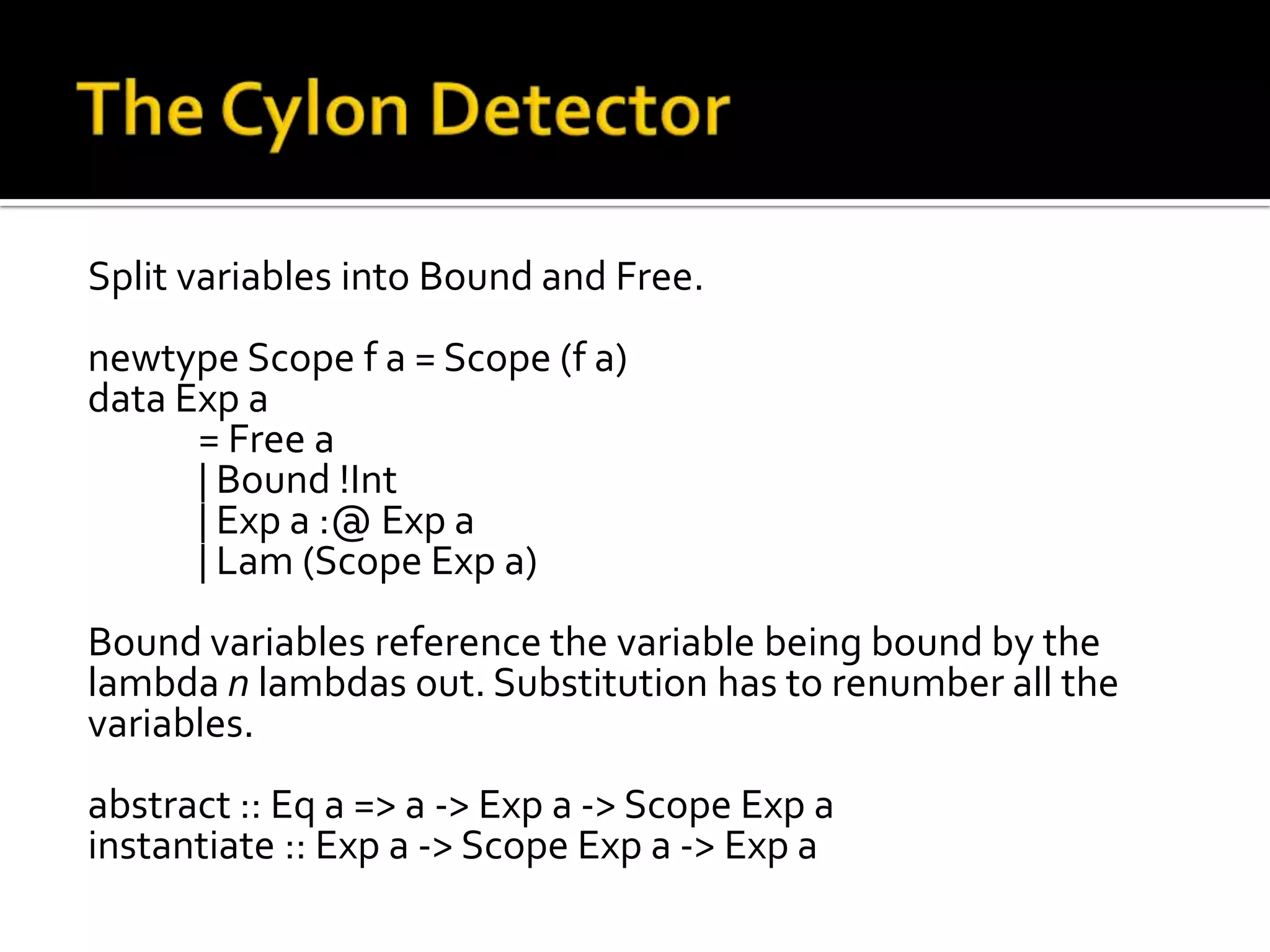
Split variables into Bound and Free.
newtype Scope f a = Scope (f a)
data Exp a
      = Free a
      | Bound !Int
      | Exp a :@ Exp a
      | Lam (Scope Exp a)
Bound variables reference the variable being bound by the
lambda n lambdas out. Substitution has to renumber all the
variables.
abstract :: Eq a => a -> Exp a -> Scope Exp a
instantiate :: Exp a -> Scope Exp a -> Exp a
Slide 14 of 50 · ·
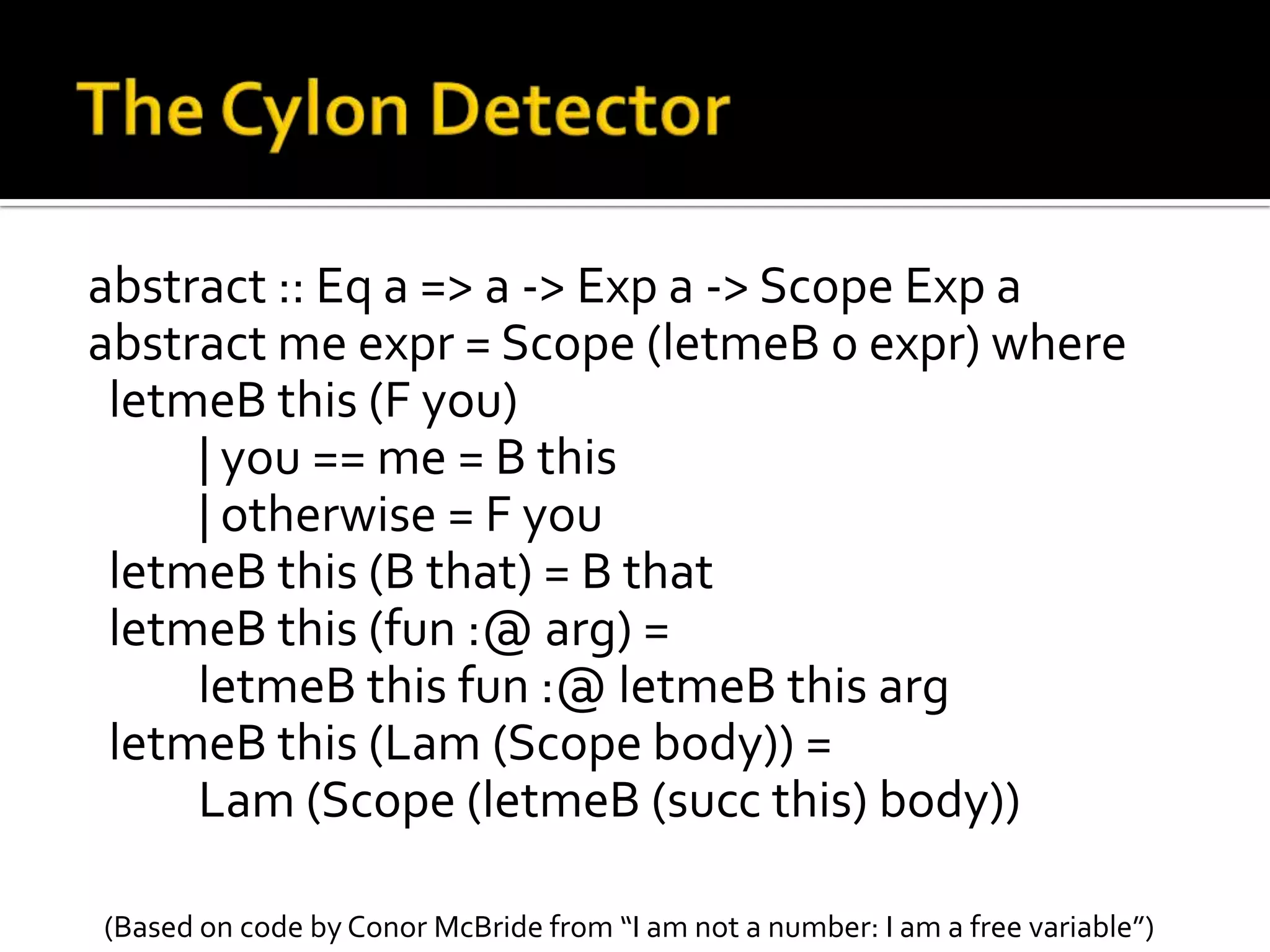
abstract :: Eq a => a -> Exp a -> Scope Exp a
abstract me expr = Scope (letmeB 0 expr) where
 letmeB this (F you)
     | you == me = B this
     | otherwise = F you
 letmeB this (B that) = B that
 letmeB this (fun :@ arg) =
     letmeB this fun :@ letmeB this arg
 letmeB this (Lam (Scope body)) =
     Lam (Scope (letmeB (succ this) body))

(Based on code by Conor McBride from “I am not a number: I am a free variable”)
Slide 15 of 50 · ·
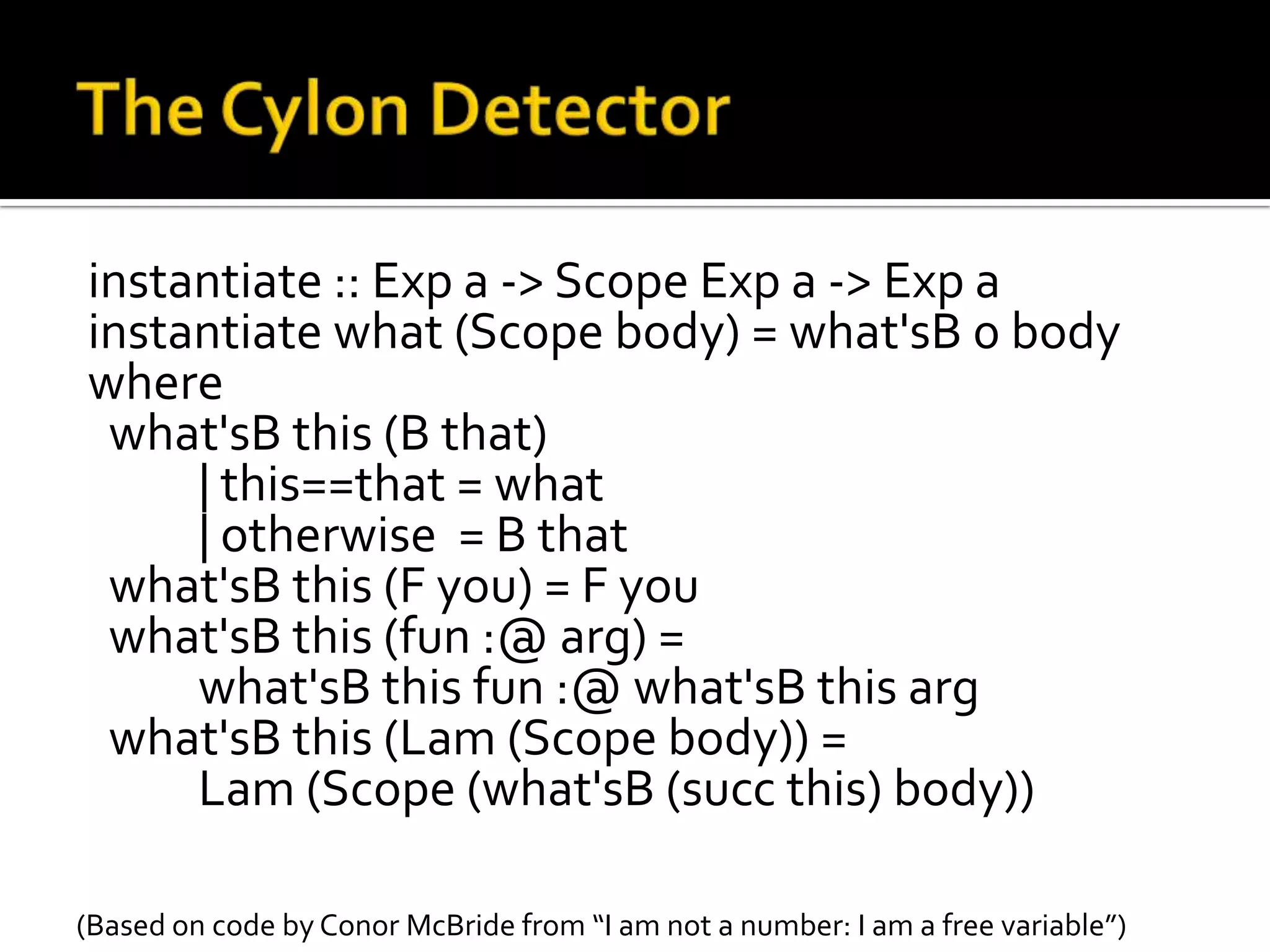
instantiate :: Exp a -> Scope Exp a -> Exp a
instantiate what (Scope body) = what'sB 0 body
where
 what'sB this (B that)
     | this==that = what
     | otherwise = B that
 what'sB this (F you) = F you
 what'sB this (fun :@ arg) =
     what'sB this fun :@ what'sB this arg
 what'sB this (Lam (Scope body)) =
     Lam (Scope (what'sB (succ this) body))

(Based on code by Conor McBride from “I am not a number: I am a free variable”)
Slide 16 of 50 · ·
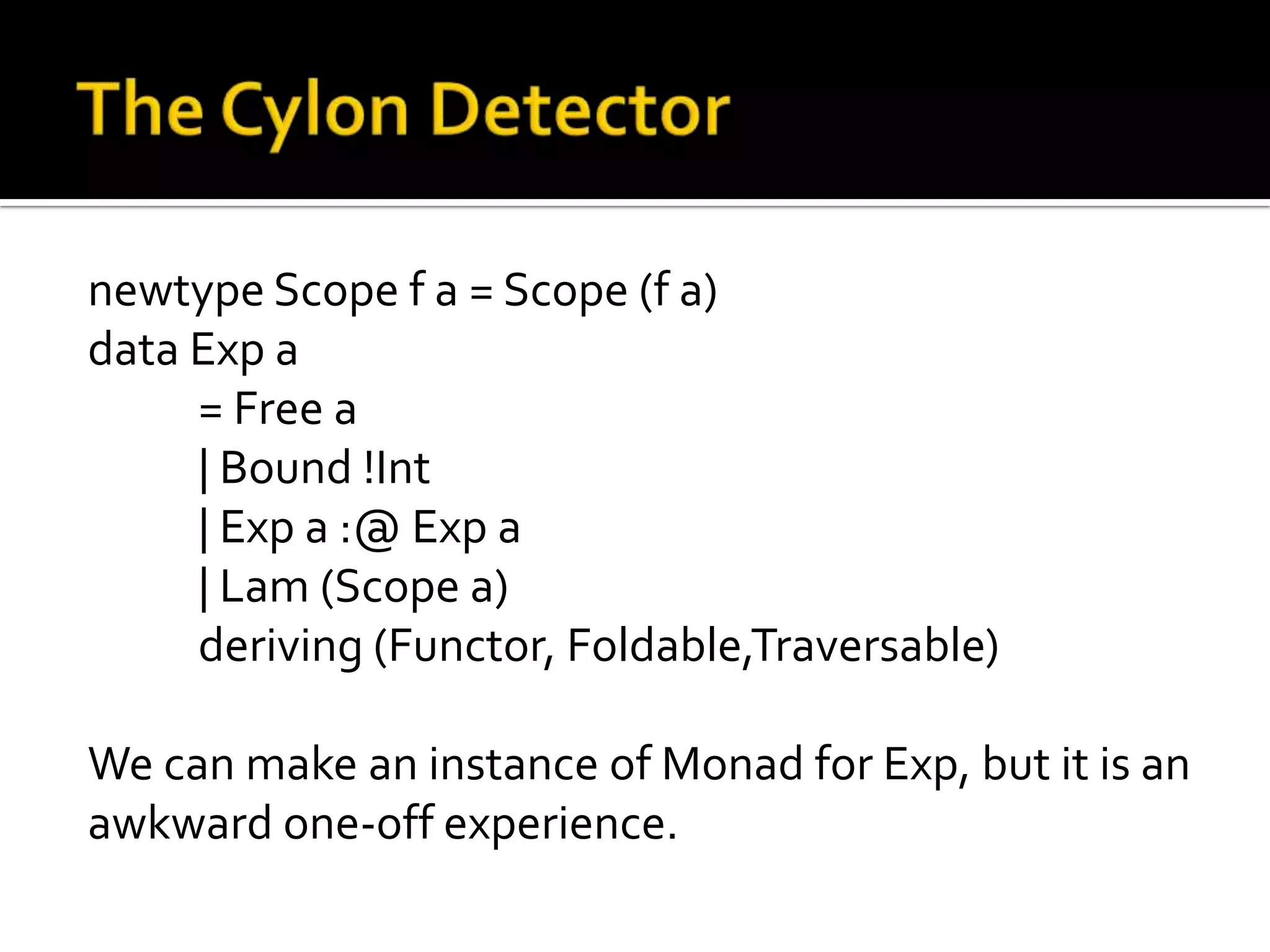
newtype Scope f a = Scope (f a)
data Exp a
     = Free a
     | Bound !Int
     | Exp a :@ Exp a
     | Lam (Scope a)
     deriving (Functor, Foldable,Traversable)

We can make an instance of Monad for Exp, but it is an
awkward one-off experience.
Slide 17 of 50 · ·
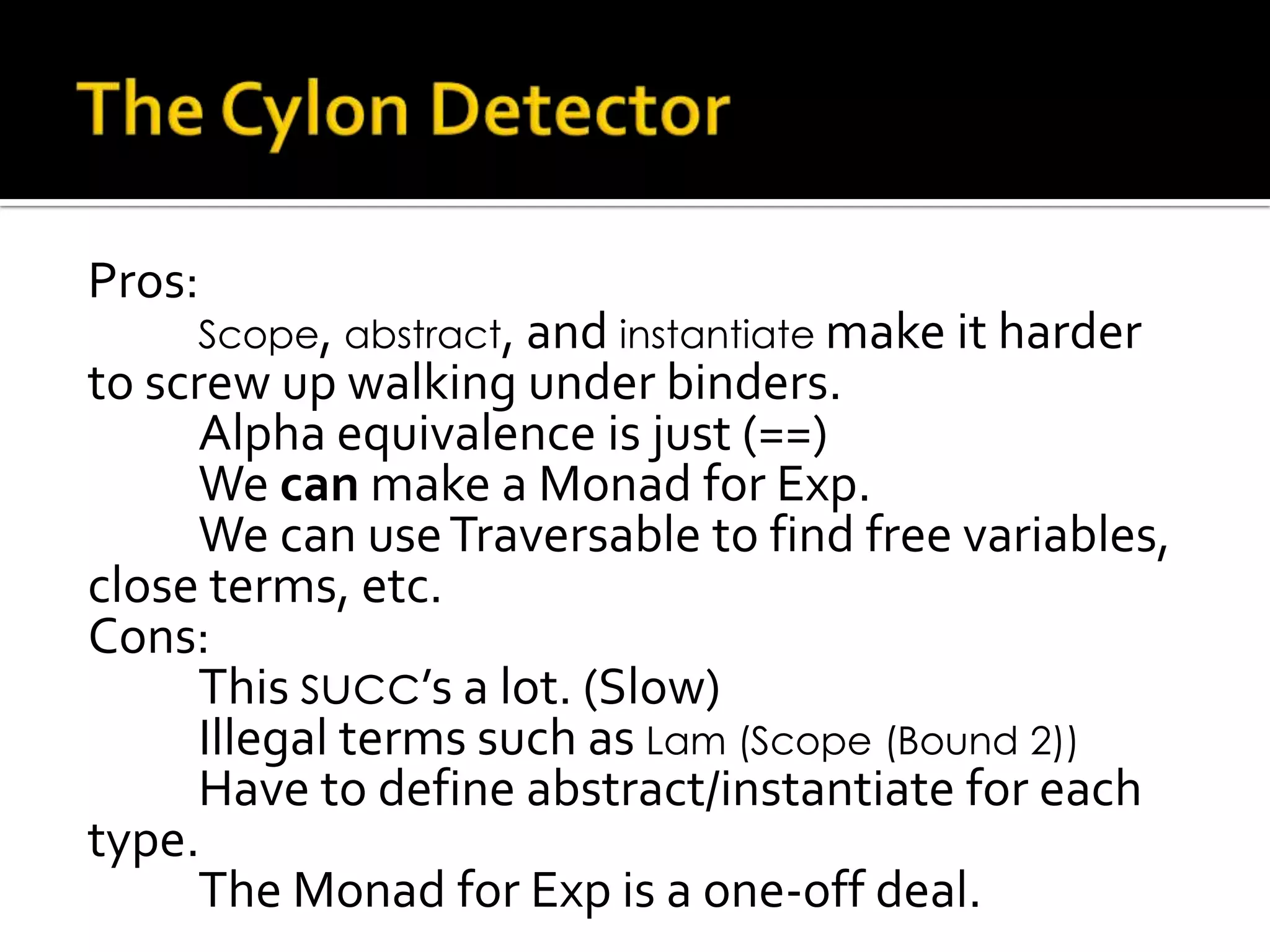
Pros:
     Scope, abstract, and instantiate make it harder
to screw up walking under binders.
      Alpha equivalence is just (==)
      We can make a Monad for Exp.
      We can use Traversable to find free variables,
close terms, etc.
Cons:
      This succ’s a lot. (Slow)
      Illegal terms such as Lam (Scope (Bound 2))
      Have to define abstract/instantiate for each
type.
      The Monad for Exp is a one-off deal.
Slide 18 of 50 · ·
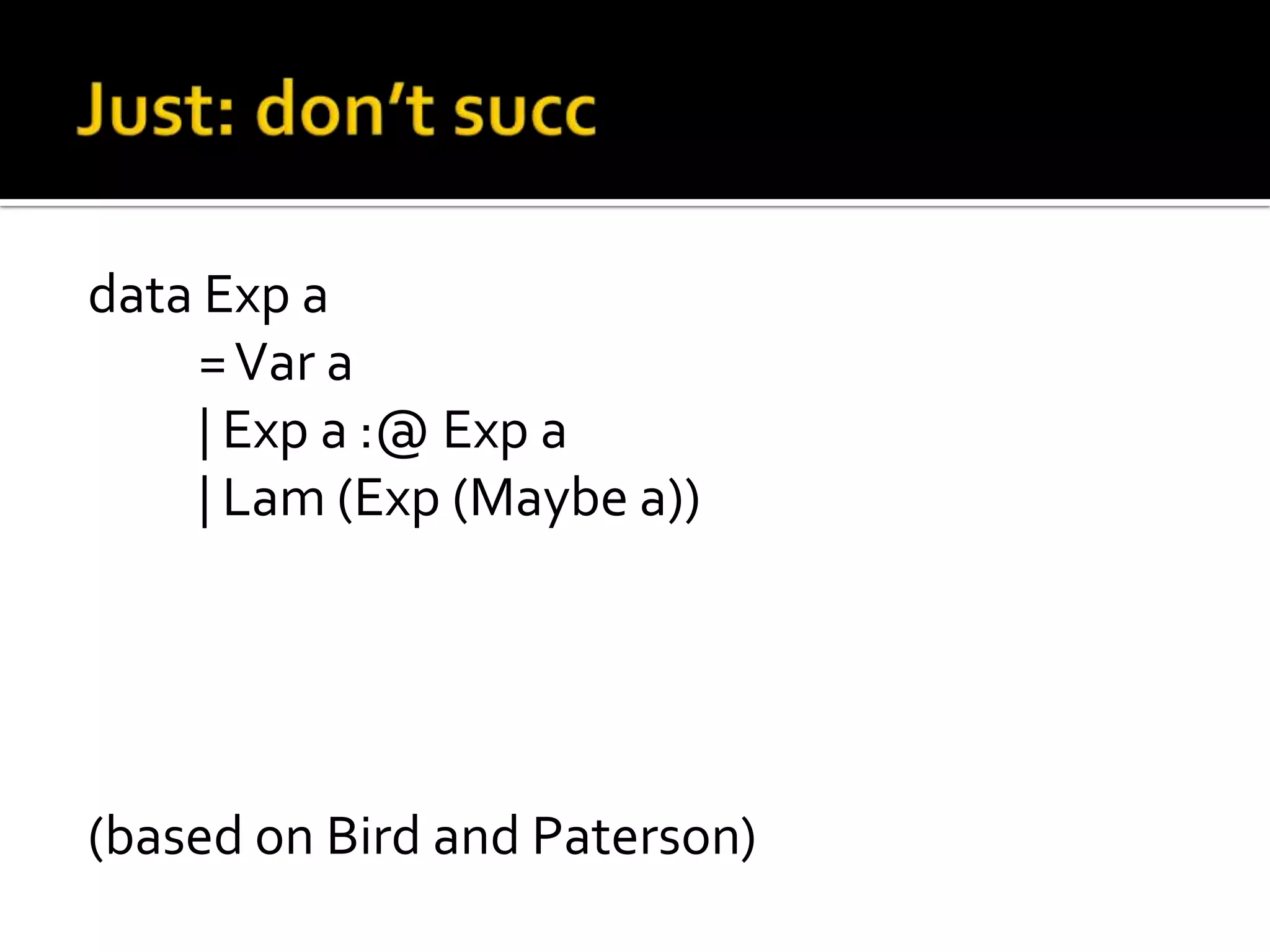
data Exp a
    = Var a
    | Exp a :@ Exp a
    | Lam (Exp (Maybe a))


(based on Bird and Paterson)
Slide 19 of 50 · ·
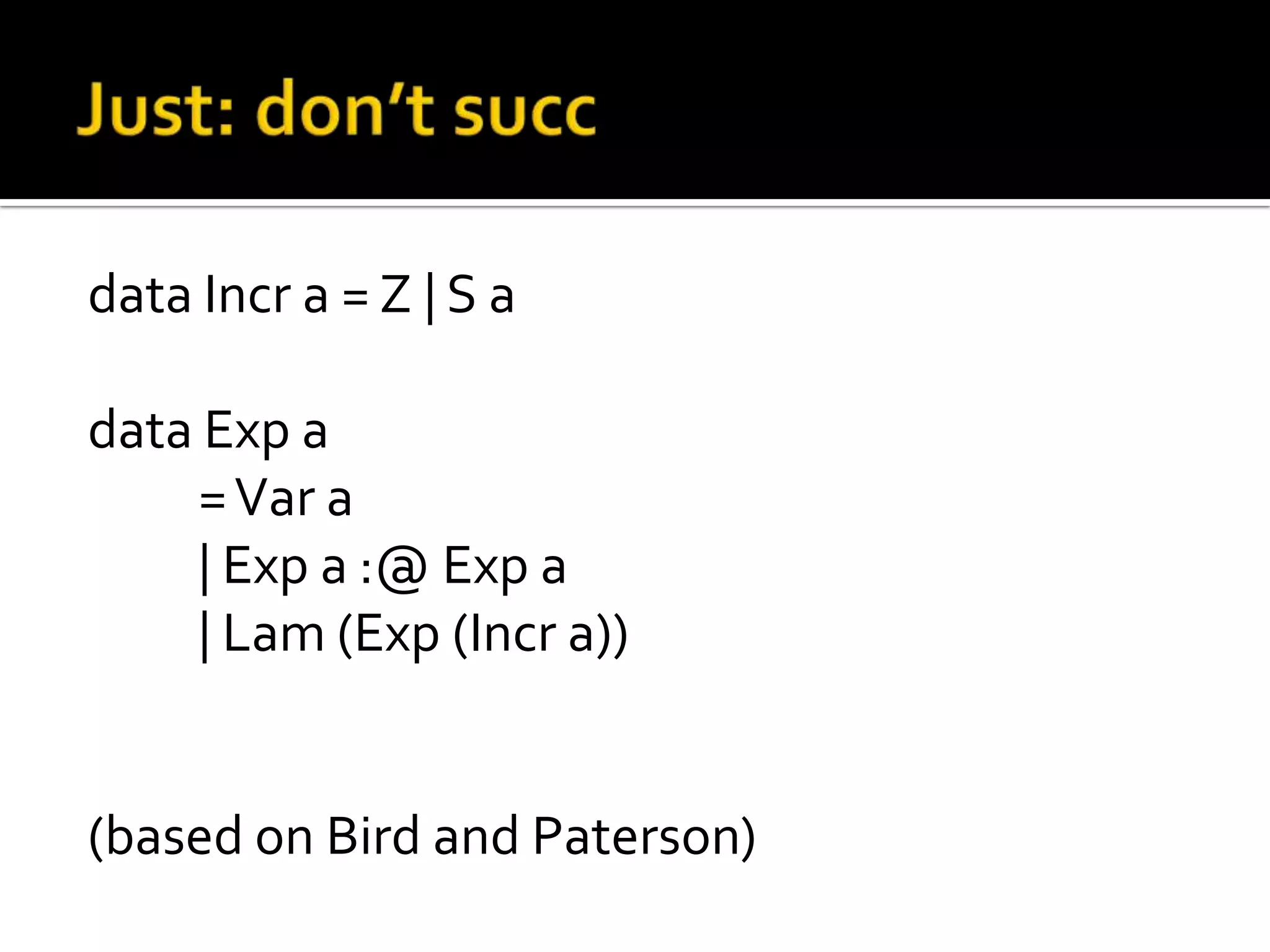
data Incr a = Z | S a

data Exp a
    = Var a
    | Exp a :@ Exp a
    | Lam (Exp (Incr a))


(based on Bird and Paterson)
Slide 20 of 50 · ·
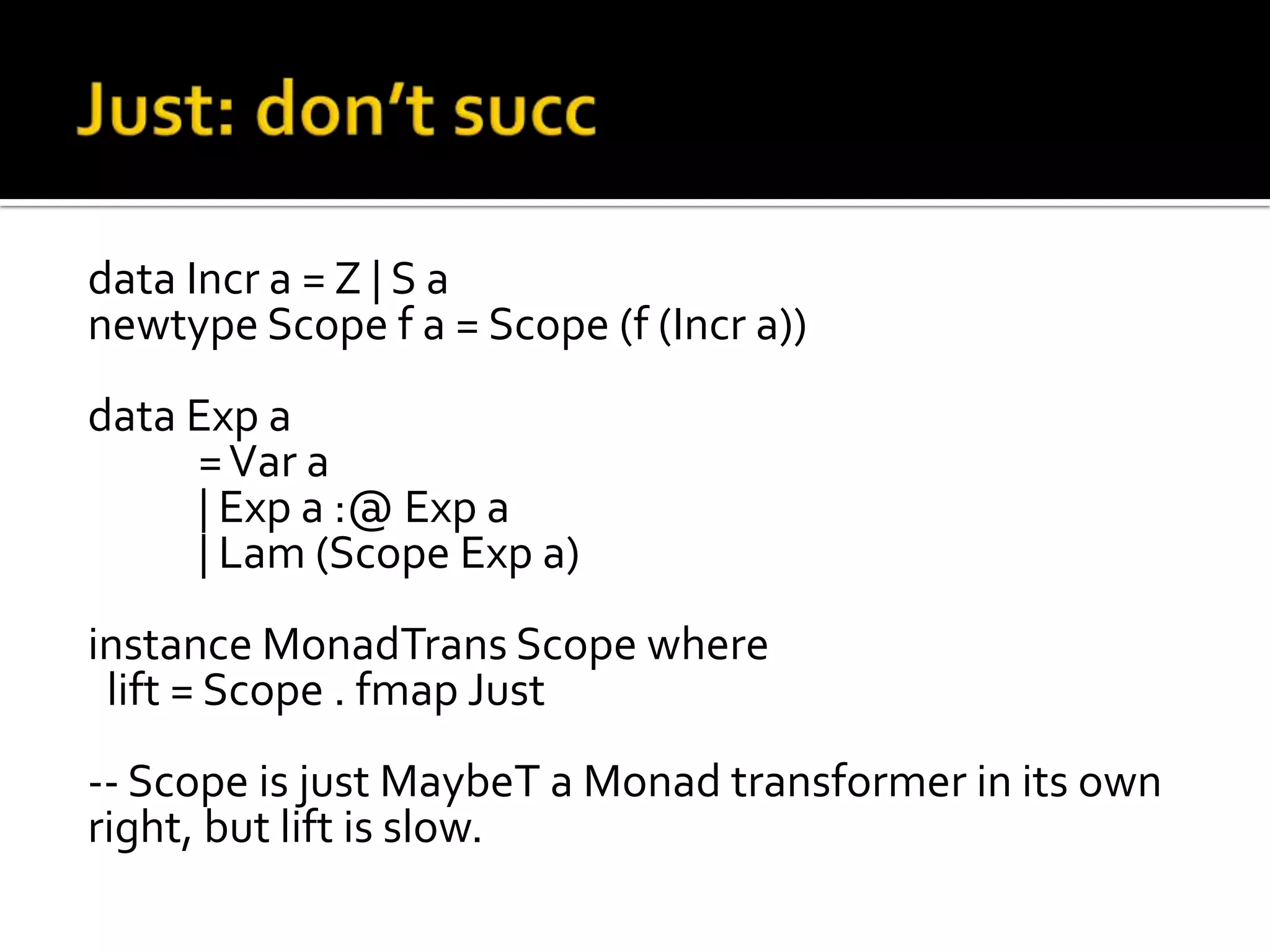
data Incr a = Z | S a
newtype Scope f a = Scope (f (Incr a))
data Exp a
     = Var a
     | Exp a :@ Exp a
     | Lam (Scope Exp a)
instance MonadTrans Scope where
 lift = Scope . fmap Just
-- Scope is just MaybeT a Monad transformer in its own
right, but lift is slow.
Slide 21 of 50 · ·
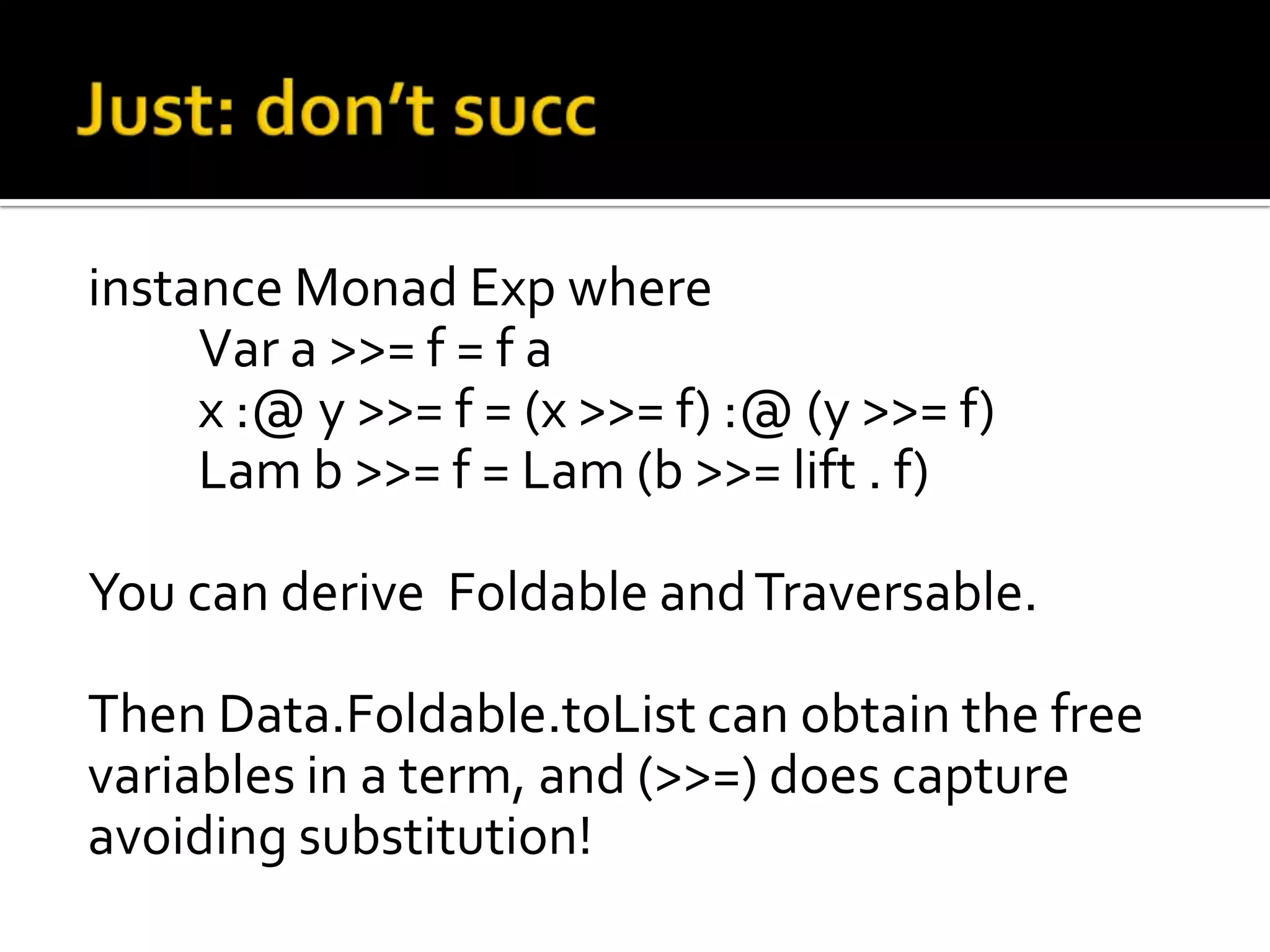
instance Monad Exp where
     Var a >>= f = f a
     x :@ y >>= f = (x >>= f) :@ (y >>= f)
     Lam b >>= f = Lam (b >>= lift . f)

You can derive Foldable and Traversable.

Then Data.Foldable.toList can obtain the free
variables in a term, and (>>=) does capture
avoiding substitution!
Slide 22 of 50 · ·
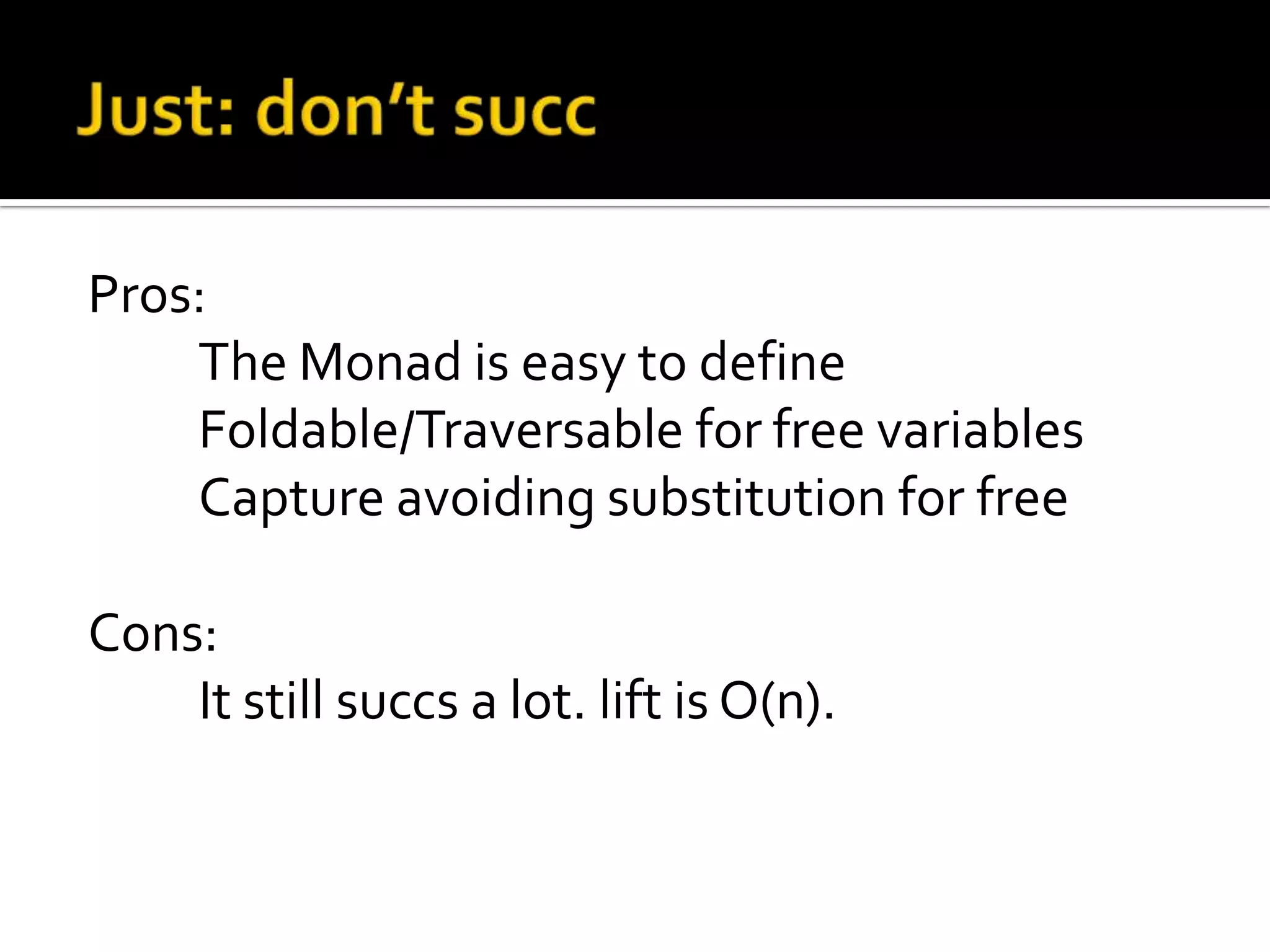
Pros:
    The Monad is easy to define
    Foldable/Traversable for free variables
    Capture avoiding substitution for free

Cons:
    It still succs a lot. lift is O(n).
Slide 23 of 50 · ·
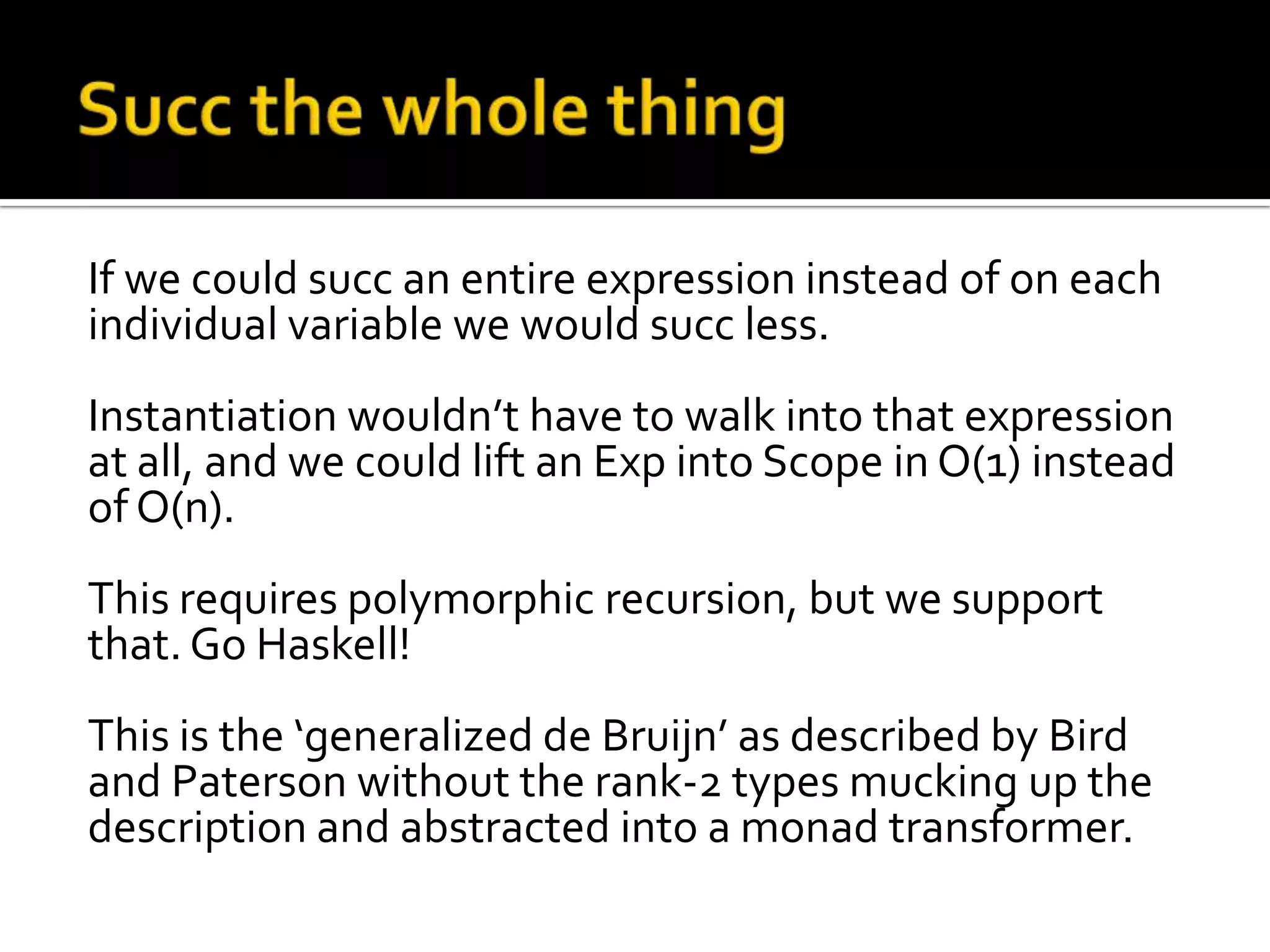
If we could succ an entire expression instead of on each
individual variable we would succ less.
Instantiation wouldn’t have to walk into that expression
at all, and we could lift an Exp into Scope in O(1) instead
of O(n).
This requires polymorphic recursion, but we support
that. Go Haskell!
This is the ‘generalized de Bruijn’ as described by Bird
and Paterson without the rank-2 types mucking up the
description and abstracted into a monad transformer.
Slide 24 of 50 · ·
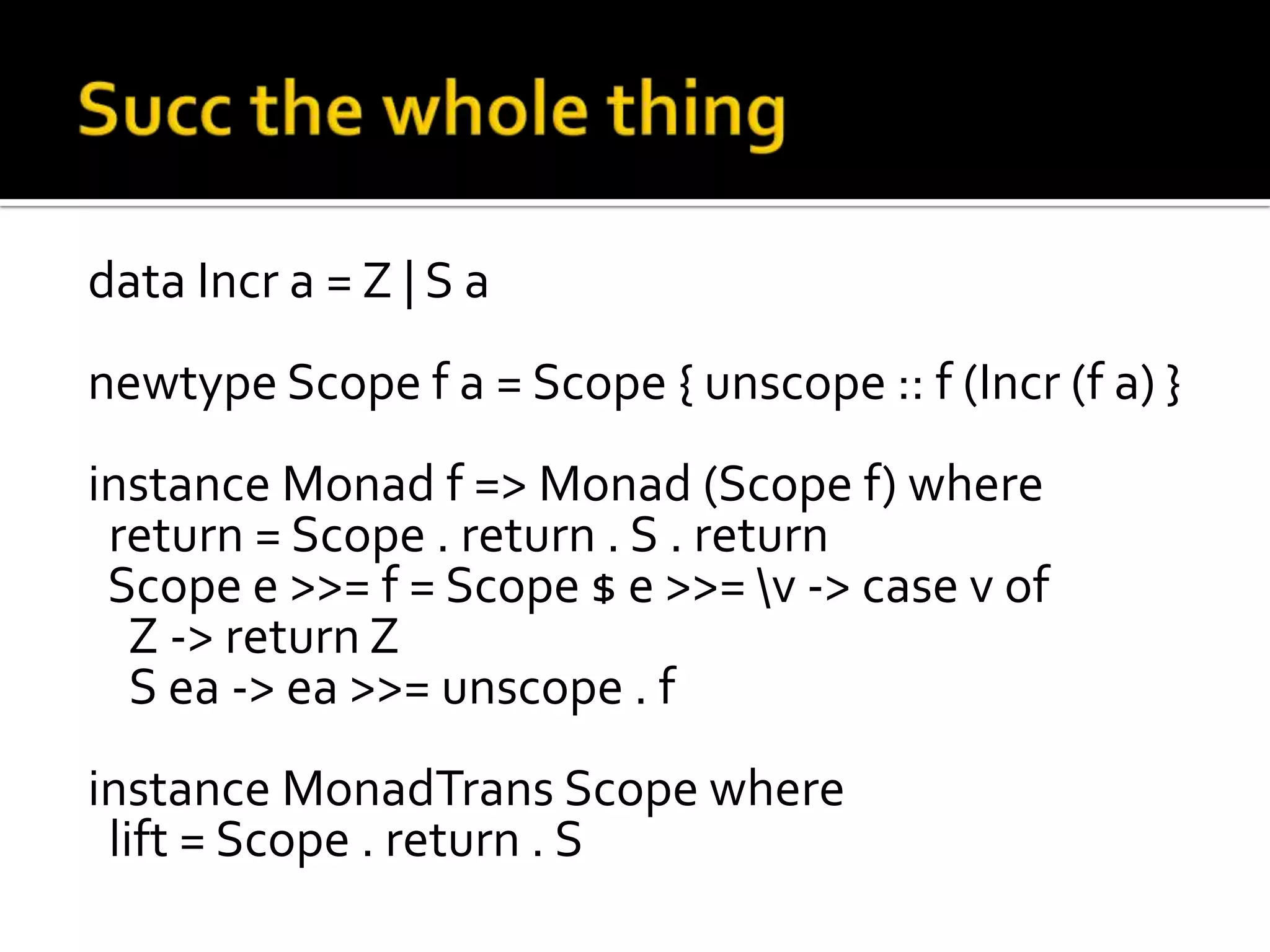
data Incr a = Z | S a
newtype Scope f a = Scope { unscope :: f (Incr (f a) }
instance Monad f => Monad (Scope f) where
 return = Scope . return . S . return
 Scope e >>= f = Scope $ e >>= v -> case v of
  Z -> return Z
  S ea -> ea >>= unscope . f
instance MonadTrans Scope where
 lift = Scope . return . S
Slide 25 of 50 · ·
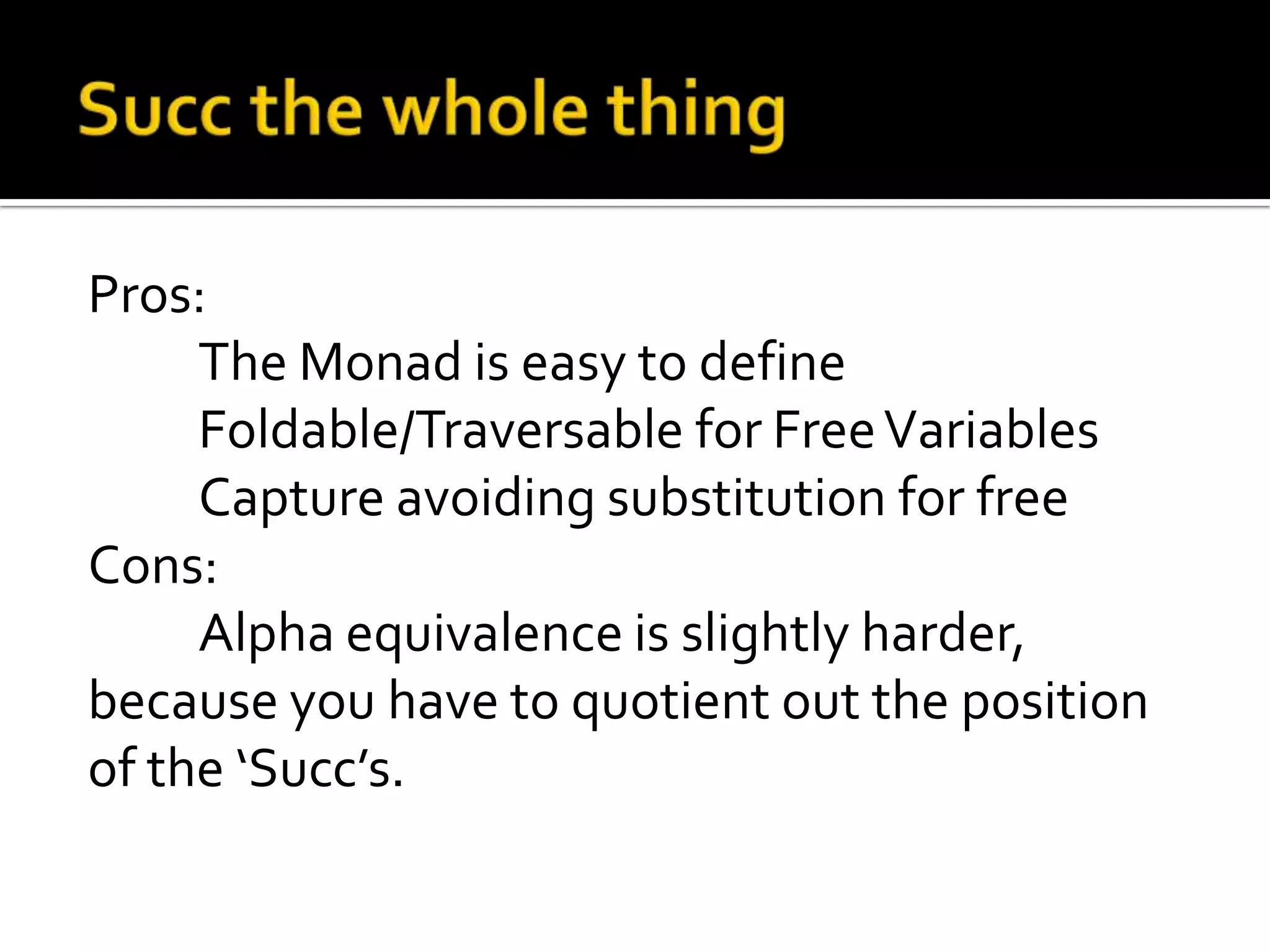
Pros:
     The Monad is easy to define
     Foldable/Traversable for Free Variables
     Capture avoiding substitution for free
Cons:
     Alpha equivalence is slightly harder,
because you have to quotient out the position
of the ‘Succ’s.
Slide 26 of 50 · ·
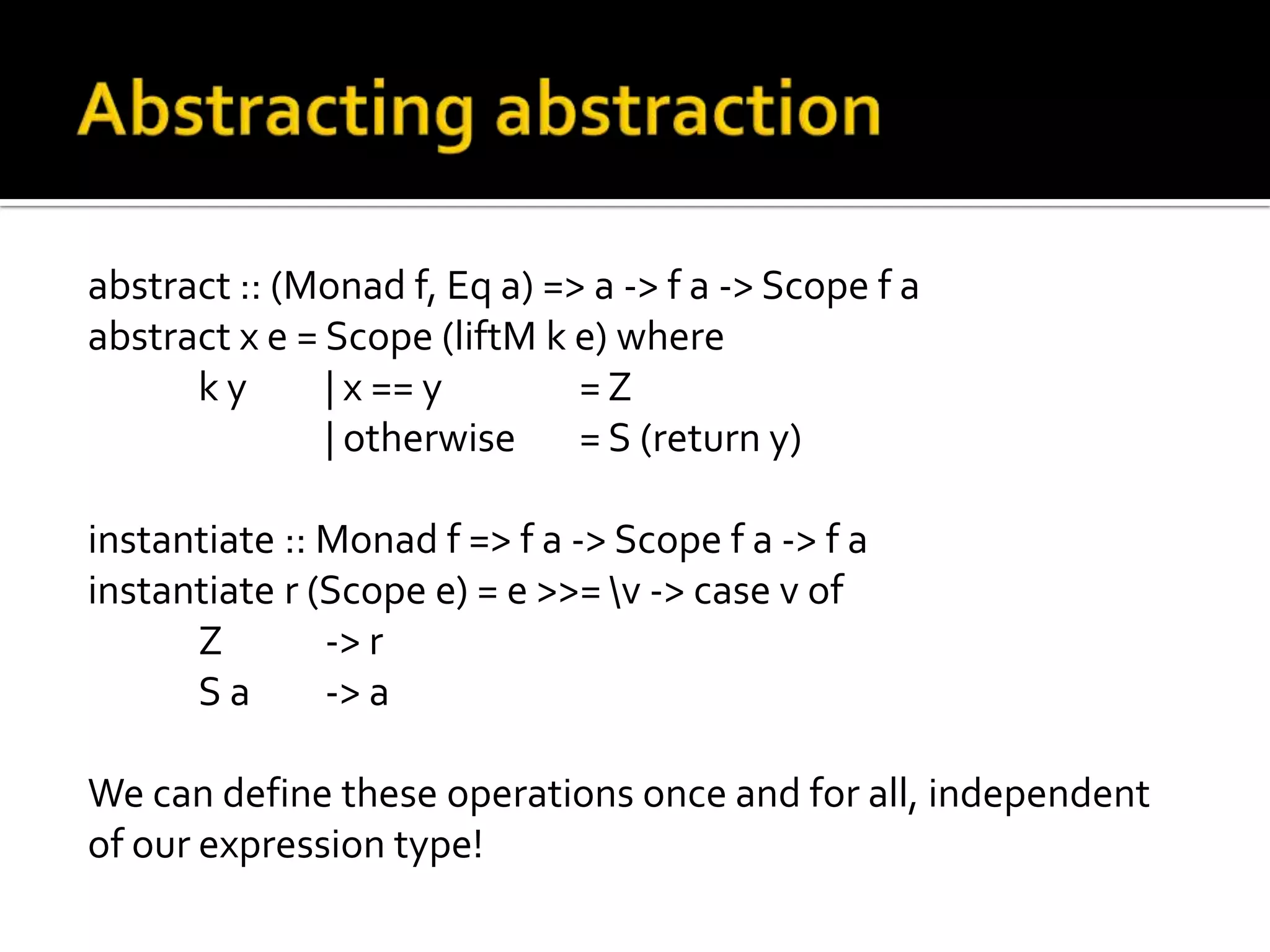
abstract :: (Monad f, Eq a) => a -> f a -> Scope f a
abstract x e = Scope (liftM k e) where
      ky       | x == y       =Z
               | otherwise = S (return y)

instantiate :: Monad f => f a -> Scope f a -> f a
instantiate r (Scope e) = e >>= v -> case v of
      Z        -> r
      Sa       -> a

We can define these operations once and for all, independent
of our expression type!
Slide 27 of 50 · ·
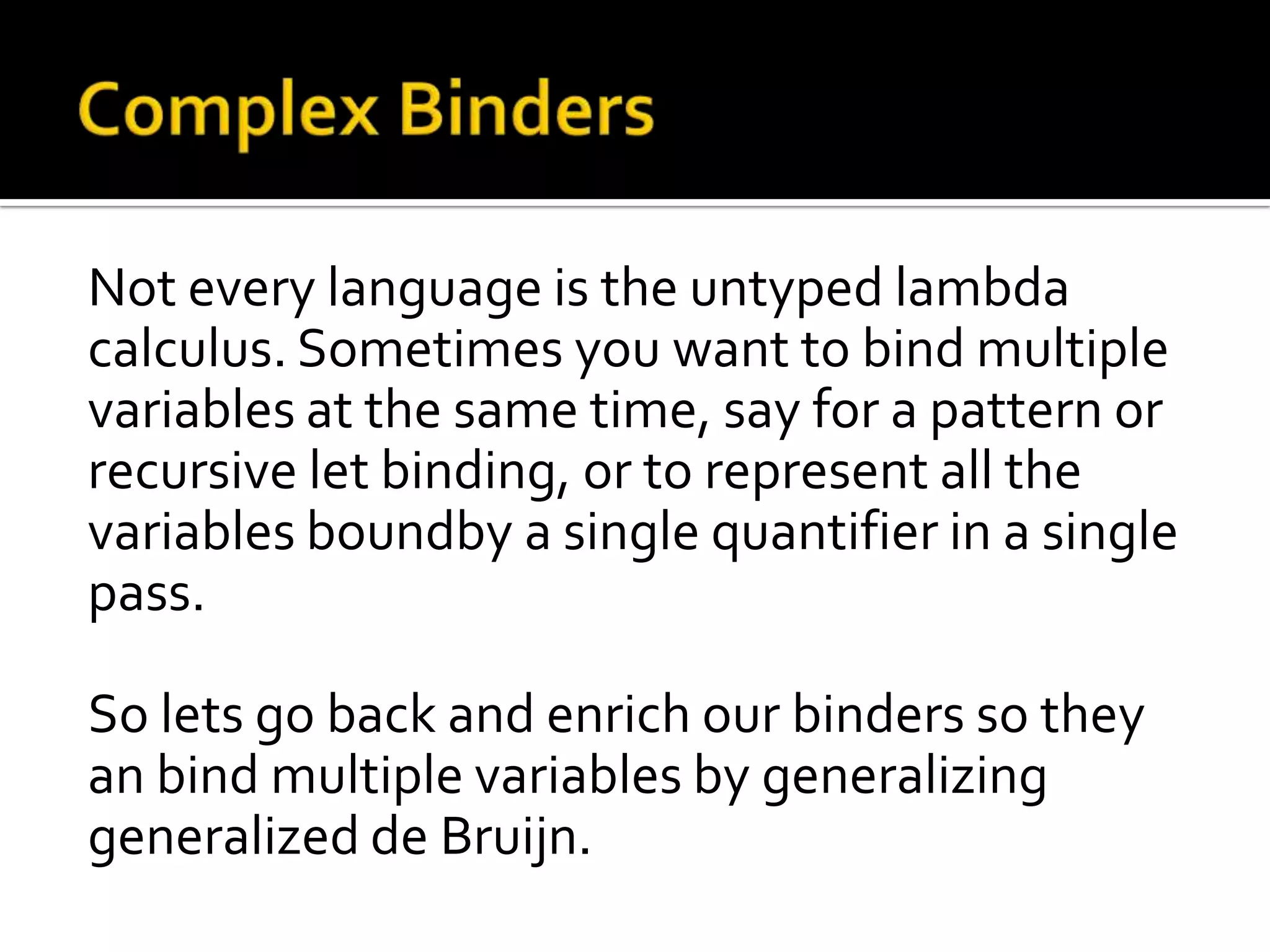
Not every language is the untyped lambda
calculus. Sometimes you want to bind multiple
variables at the same time, say for a pattern or
recursive let binding, or to represent all the
variables boundby a single quantifier in a single
pass.

So lets go back and enrich our binders so they
an bind multiple variables by generalizing
generalized de Bruijn.
Slide 28 of 50 · ·
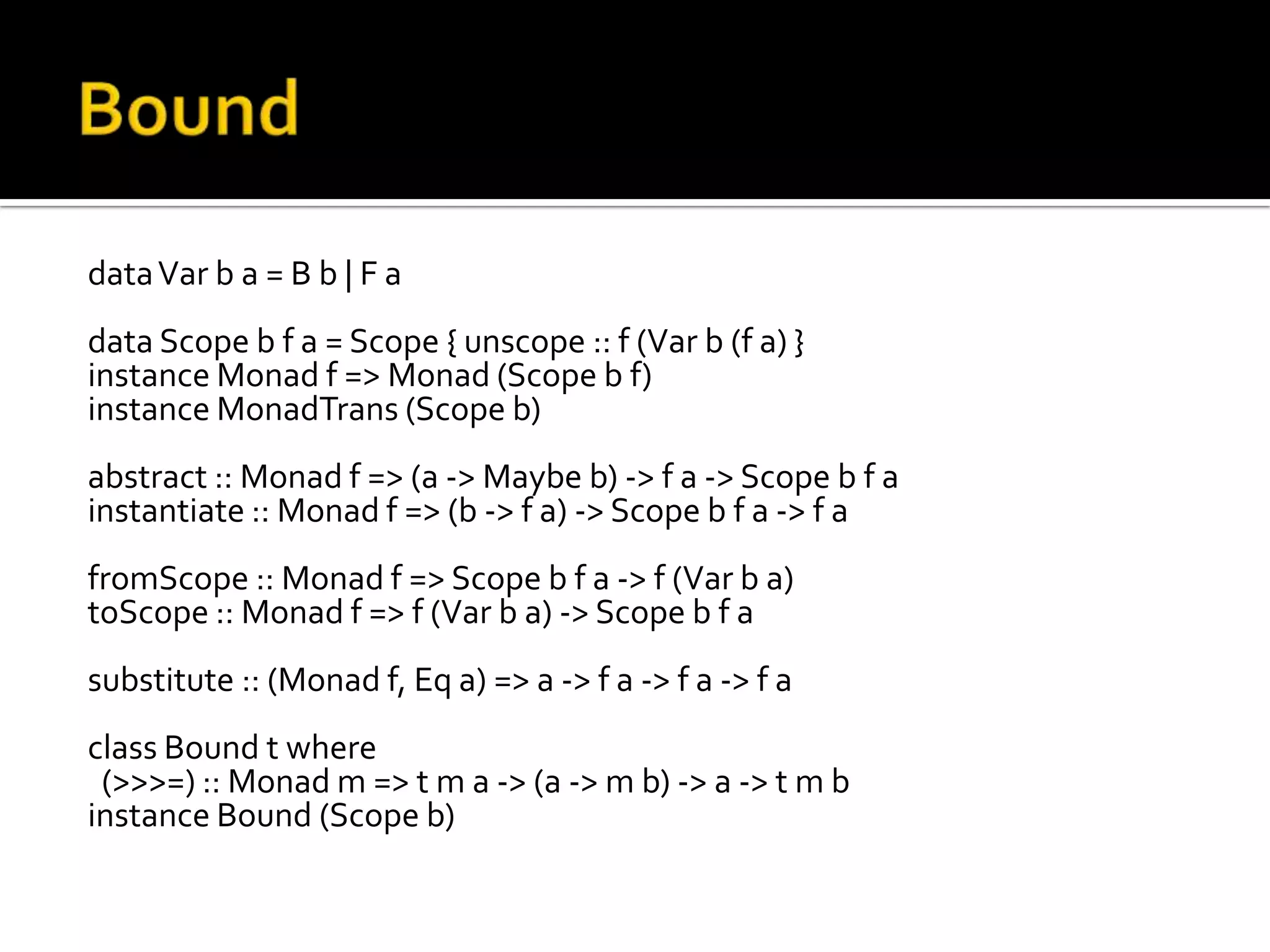
data Var b a = B b | F a
data Scope b f a = Scope { unscope :: f (Var b (f a) }
instance Monad f => Monad (Scope b f)
instance MonadTrans (Scope b)
abstract :: Monad f => (a -> Maybe b) -> f a -> Scope b f a
instantiate :: Monad f => (b -> f a) -> Scope b f a -> f a
fromScope :: Monad f => Scope b f a -> f (Var b a)
toScope :: Monad f => f (Var b a) -> Scope b f a
substitute :: (Monad f, Eq a) => a -> f a -> f a -> f a
class Bound t where
 (>>>=) :: Monad m => t m a -> (a -> m b) -> a -> t m b
instance Bound (Scope b)
Slide 29 of 50 · ·
data Exp a
 =V a
 | Exp a :@ Exp a
 | Lam (Scope () Exp a)
 | Let [Scope Int Exp a] (Scope Int Exp a)
 deriving (Eq,Ord,Show,Read,Functor,Foldable,Traversable)

Instance Monad Exp where
  Va        >>= f = f a
 (x :@ y)   >>= f = (x >>= f) :@ (y >>= f)
 Lam e      >>= f = Lam (e >>>= f)
 Let bs b   >>= f = Let (map (>>>= f) bs) (b >>>= f)
Slide 30 of 50 · ·
abstract1 :: (Monad f, Eq a) => a -> f a -> Scope () f a
abstract :: Monad f => (a -> Maybe b) -> f a -> Scope b f a

lam :: Eq a => a -> Exp a -> Exp a
lam v b = Lam (abstract1 v b)

let_ :: Eq a => [(a,Exp a)] -> Exp a -> Exp a
let_ bs b = Let (map (abstr . snd) bs) (abstr b)
 where abstr = abstract (`elemIndex` map fst bs)

infixr 0 !
(!) :: Eq a => a -> Exp a -> Exp a
(!) = lam
Slide 31 of 50 · ·
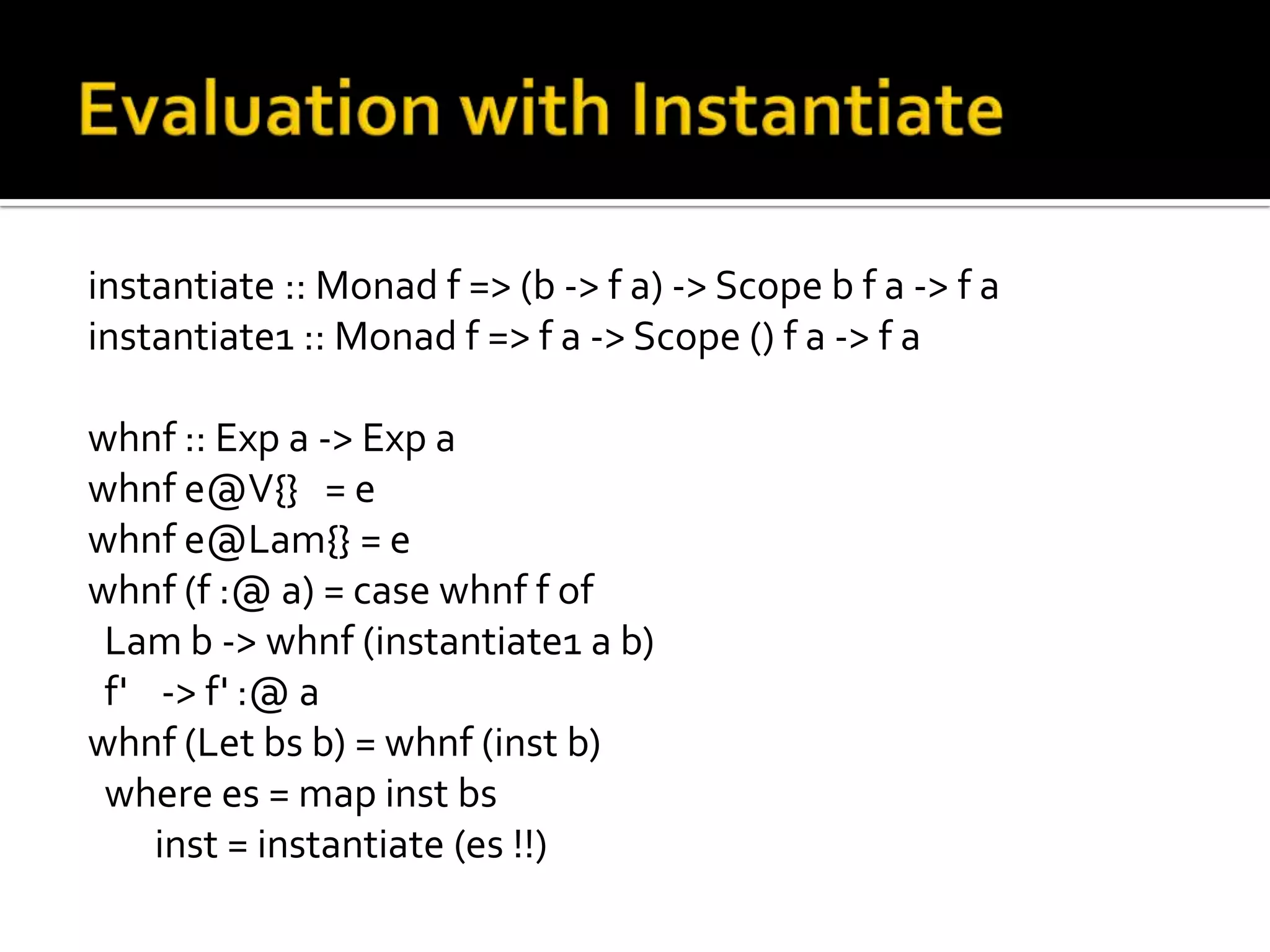
instantiate :: Monad f => (b -> f a) -> Scope b f a -> f a
instantiate1 :: Monad f => f a -> Scope () f a -> f a

whnf :: Exp a -> Exp a
whnf e@V{} = e
whnf e@Lam{} = e
whnf (f :@ a) = case whnf f of
 Lam b -> whnf (instantiate1 a b)
 f' -> f' :@ a
whnf (Let bs b) = whnf (inst b)
 where es = map inst bs
    inst = instantiate (es !!)
Slide 32 of 50 · ·
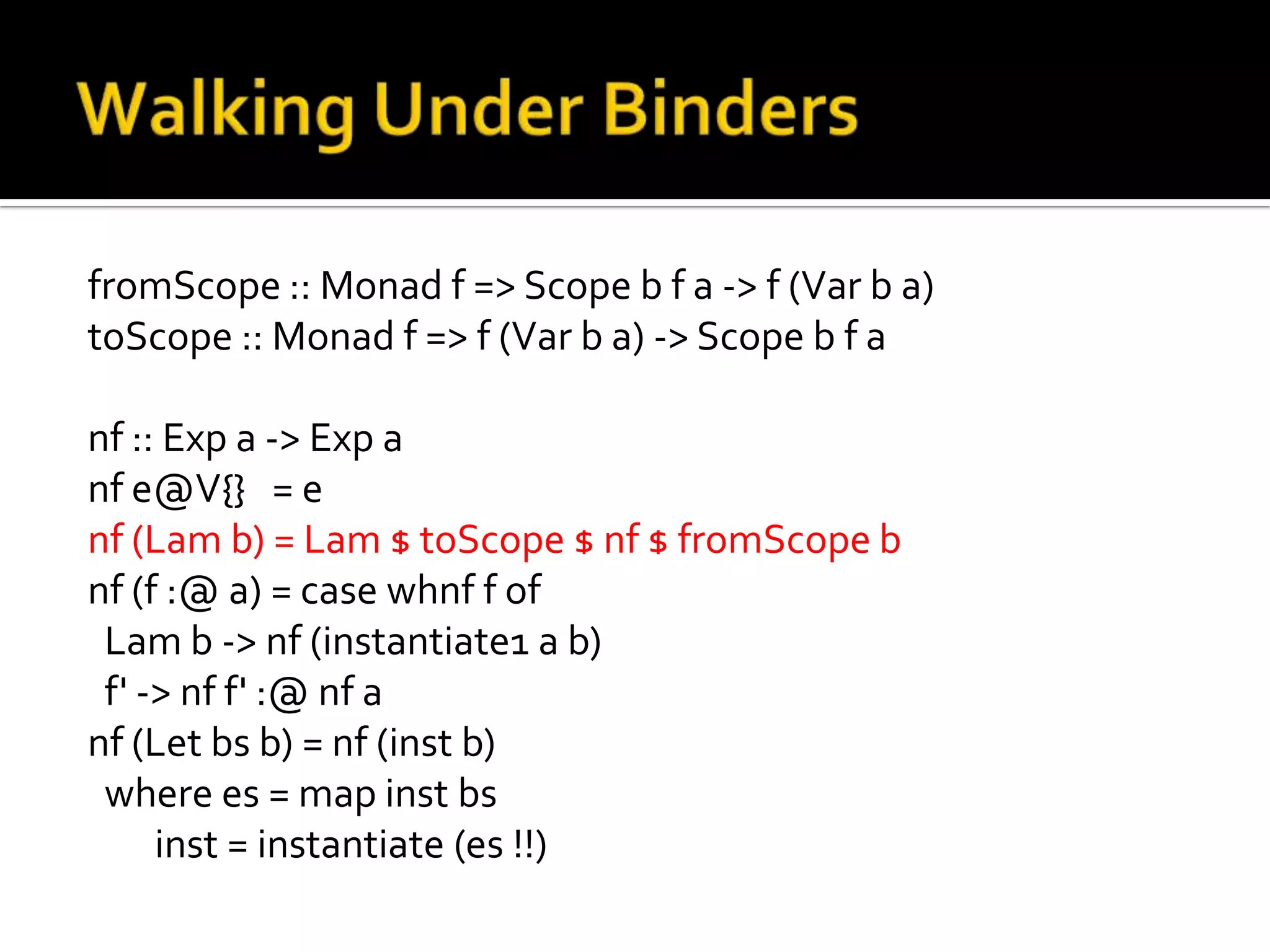
fromScope :: Monad f => Scope b f a -> f (Var b a)
toScope :: Monad f => f (Var b a) -> Scope b f a

nf :: Exp a -> Exp a
nf e@V{} = e
nf (Lam b) = Lam $ toScope $ nf $ fromScope b
nf (f :@ a) = case whnf f of
 Lam b -> nf (instantiate1 a b)
 f' -> nf f' :@ nf a
nf (Let bs b) = nf (inst b)
 where es = map inst bs
     inst = instantiate (es !!)
Slide 33 of 50 · ·
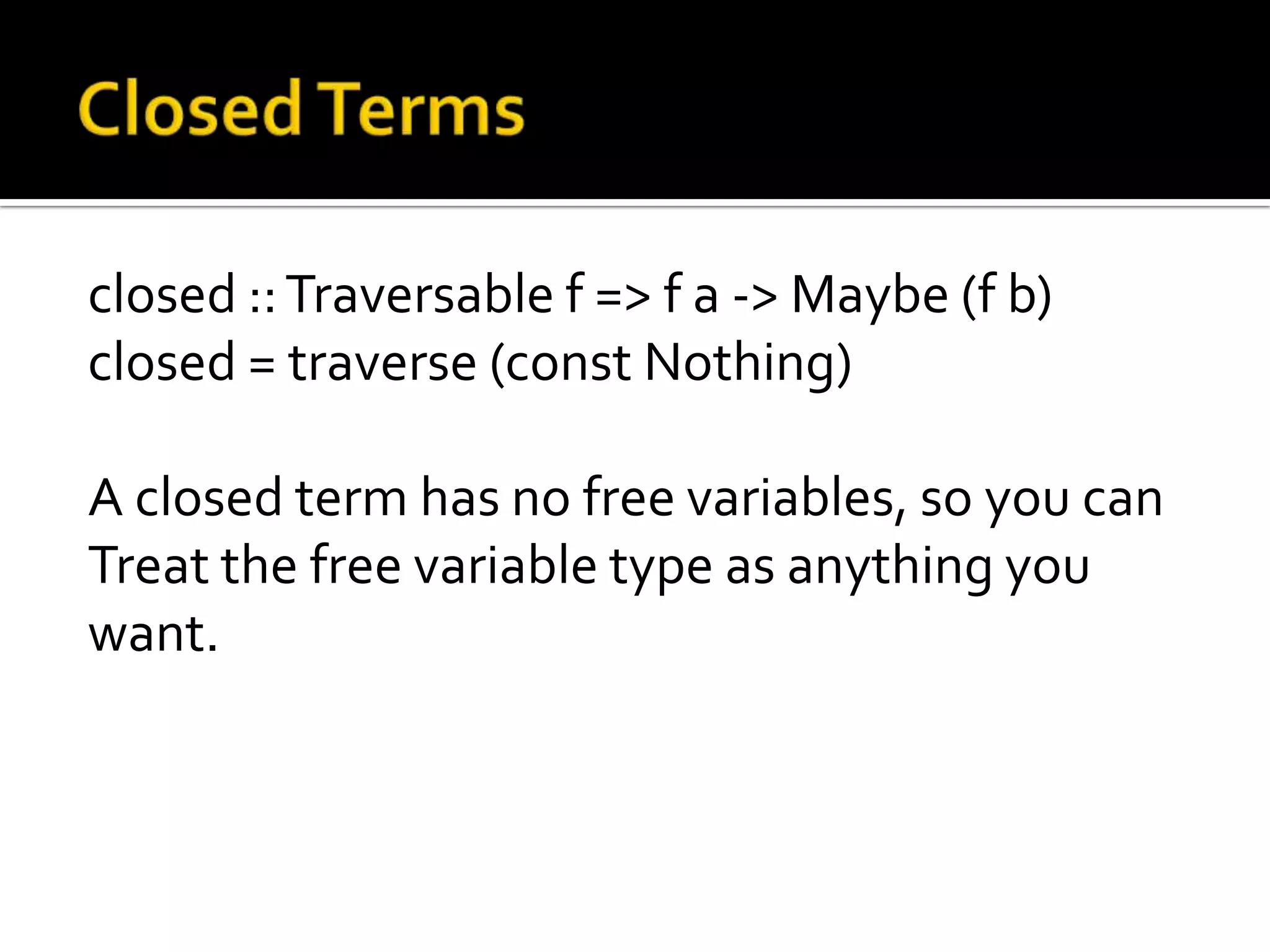
closed :: Traversable f => f a -> Maybe (f b)
closed = traverse (const Nothing)

A closed term has no free variables, so you can
Treat the free variable type as anything you
want.
Slide 34 of 50 · ·
cooked :: Exp a
cooked = fromJust $ closed $ let_
 [ ("False", "f" ! "t" ! V"f")
 , ("True", "f" ! "t" ! V"t")
 , ("if", "b" ! "t" ! "f" ! V"b" :@ V"f" :@ V"t")
 , ("Zero", "z" ! "s" ! V"z")
 , ("Succ", "n" ! "z" ! "s" ! V"s" :@ V"n")
 , ("one", V"Succ" :@ V"Zero")
 , ("two", V"Succ" :@ V"one")
 , ("three", V"Succ" :@ V"two")
 , ("isZero", "n" ! V"n" :@ V"True" :@ ("m" ! V"False"))
 , ("const", "x" ! "y" ! V"x")
 , ("Pair", "a" ! "b" ! "p" ! V"p" :@ V"a" :@ V"b")
 , ("fst", "ab" ! V"ab" :@ ("a" ! "b" ! V"a"))
 , ("snd", "ab" ! V"ab" :@ ("a" ! "b" ! V"b"))
 , ("add", "x" ! "y" ! V"x" :@ V"y" :@ ("n" ! V"Succ" :@ (V"add" :@ V"n" :@ V"y")))
 , ("mul", "x" ! "y" ! V"x" :@ V"Zero" :@ ("n" ! V"add" :@ V"y" :@ (V"mul" :@ V"n" :@ V"y")))
 , ("fac", "x" ! V"x" :@ V"one" :@ ("n" ! V"mul" :@ V"x" :@ (V"fac" :@ V"n")))
 , ("eqnat", "x" ! "y" ! V"x" :@ (V"y" :@ V"True" :@ (V"const" :@ V"False")) :@ ("x1" ! V"y" :@ V"False" :@ ("y1" ! V"eqnat" :@ V"x1" :@
V"y1")))
 , ("sumto", "x" ! V"x" :@ V"Zero" :@ ("n" ! V"add" :@ V"x" :@ (V"sumto" :@ V"n")))
 , ("n5", V"add" :@ V"two" :@ V"three")
 , ("n6", V"add" :@ V"three" :@ V"three")
 , ("n17", V"add" :@ V"n6" :@ (V"add" :@ V"n6" :@ V"n5"))
 , ("n37", V"Succ" :@ (V"mul" :@ V"n6" :@ V"n6"))
 , ("n703", V"sumto" :@ V"n37")
 , ("n720", V"fac" :@ V"n6")
 ] (V"eqnat" :@ V"n720" :@ (V"add" :@ V"n703" :@ V"n17"))
Slide 35 of 50 · ·
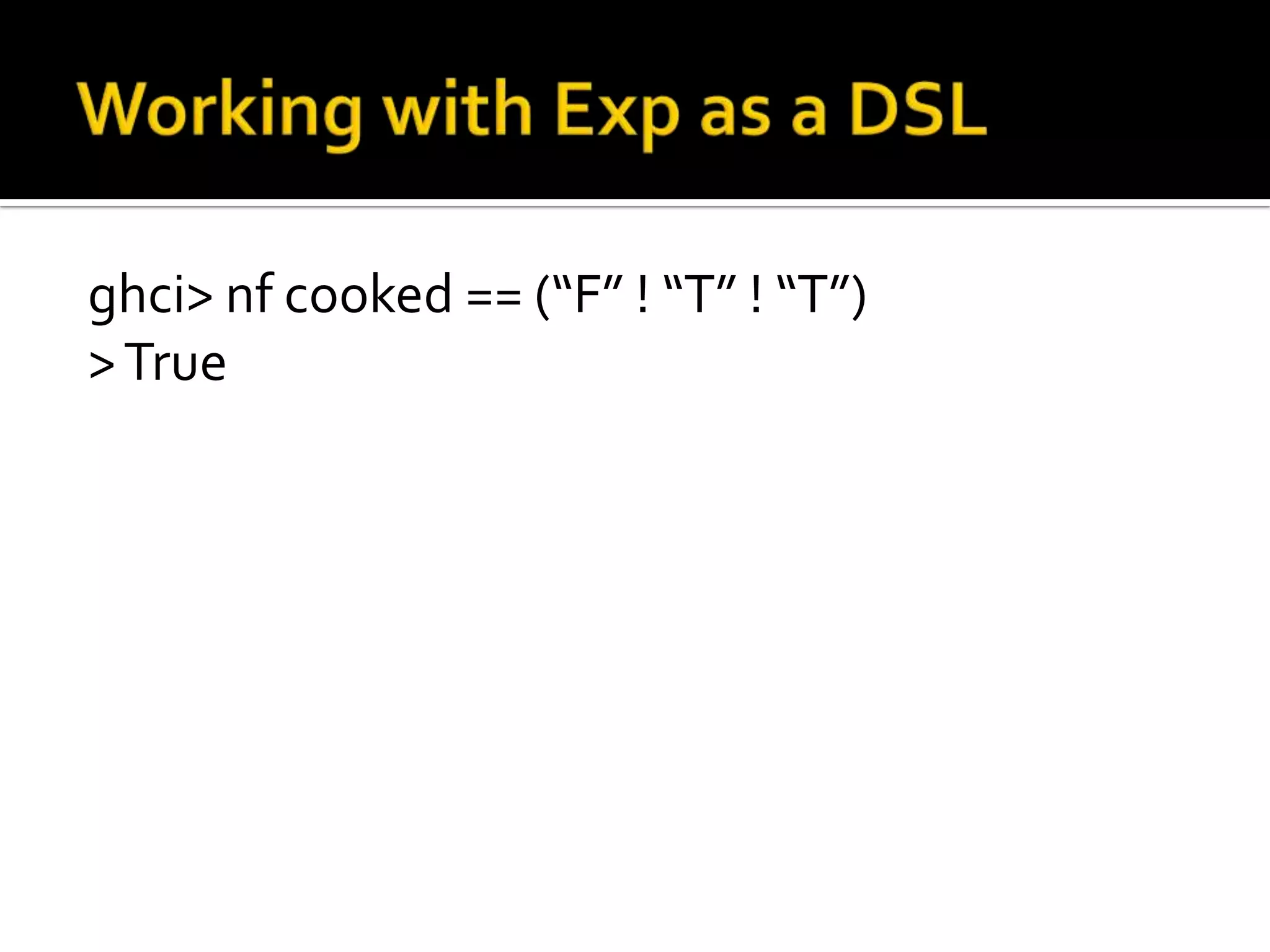
ghci> nf cooked == (“F” ! “T” ! “T”)
> True
Slide 36 of 50 · ·
data Exp a
 =V a
 | Exp a :@ Exp a
 | Lam !Int (Pat Exp a) (Scope Int Exp a)
 | Let !Int [Scope Int Exp a] (Scope Int Exp a)
 | Case (Exp a) [Alt Exp a]
 deriving (Eq,Ord,Show,Read,Functor,Foldable,Traversable)
data Pat f a
 = VarP
 | WildP
 | AsP (Pat f a)
 | ConP String [Pat f a]
 | ViewP (Scope Int f a) (Pat f a)
 deriving (Eq,Ord,Show,Read,Functor,Foldable,Traversable)
data Alt f a = Alt !Int (Pat f a) (Scope Int f a)
deriving (Eq,Ord,Show,Read,Functor,Foldable,Traversable)
Slide 37 of 50 · ·
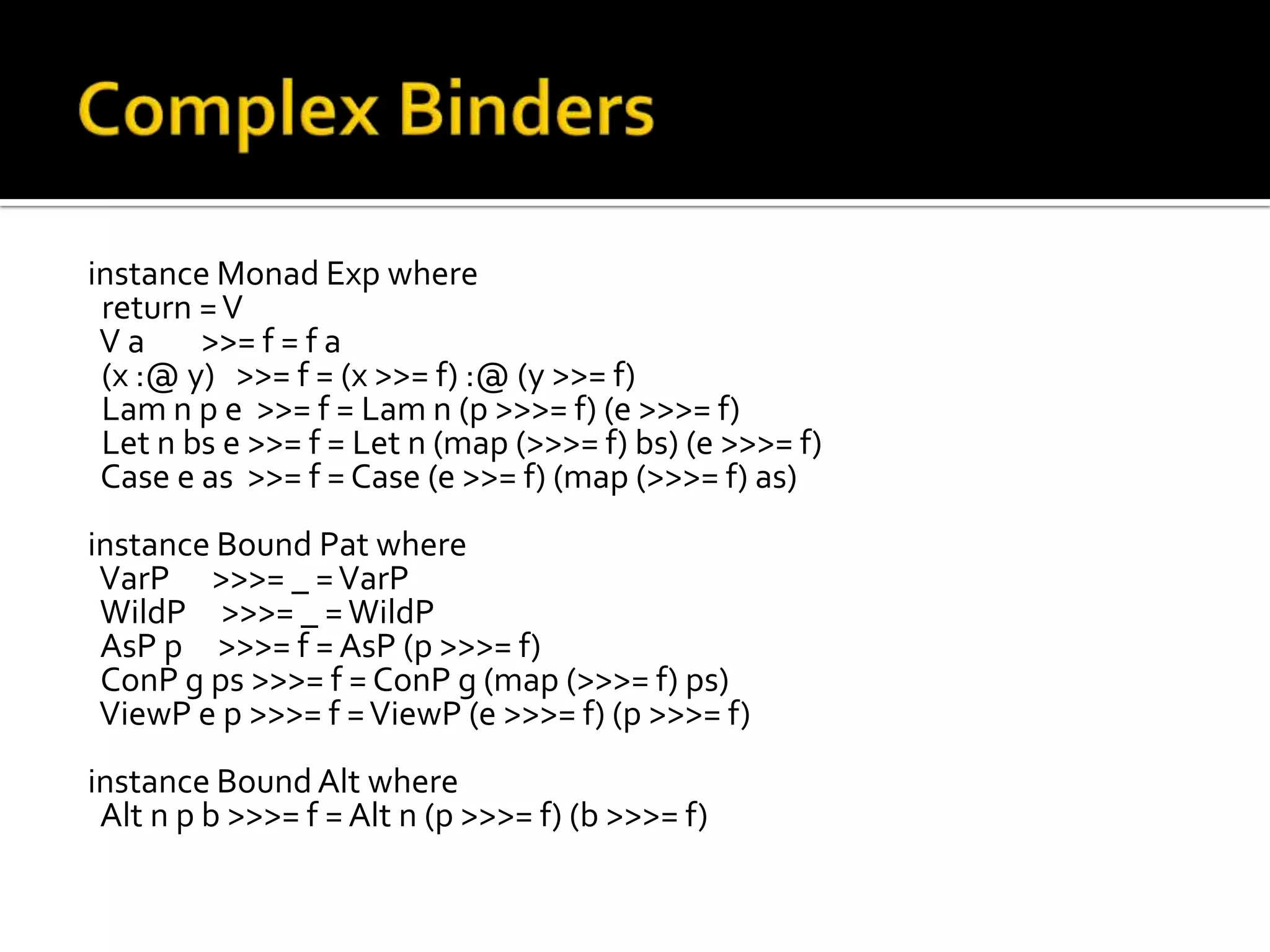
instance Monad Exp where
 return = V
 Va     >>= f = f a
 (x :@ y) >>= f = (x >>= f) :@ (y >>= f)
 Lam n p e >>= f = Lam n (p >>>= f) (e >>>= f)
 Let n bs e >>= f = Let n (map (>>>= f) bs) (e >>>= f)
 Case e as >>= f = Case (e >>= f) (map (>>>= f) as)
instance Bound Pat where
 VarP >>>= _ = VarP
 WildP >>>= _ = WildP
 AsP p >>>= f = AsP (p >>>= f)
 ConP g ps >>>= f = ConP g (map (>>>= f) ps)
 ViewP e p >>>= f = ViewP (e >>>= f) (p >>>= f)
instance Bound Alt where
 Alt n p b >>>= f = Alt n (p >>>= f) (b >>>= f)
Slide 38 of 50 · ·
data P a = P { pattern :: [a] -> Pat Exp a, bindings :: [a] }
varp :: a -> P a
varp a = P (const VarP) [a]
wildp :: P a
wildp = P (const WildP) []
conp :: String -> [P a] -> P a
conp g ps = P (ConP g . go ps) (ps >>= bindings)
 where
  go (P p as:ps) bs = p bs : go ps (bs ++ as)
  go [] _ = []
lam :: Eq a => P a -> Exp a -> Exp a
lam (P p as) t = Lam (length as) (p []) (abstract (`elemIndex` as) t)
ghci> lam (varp "x") (V "x”)
Lam 1 VarP (Scope (V (B 0)))
ghci> lam (conp "Hello" [varp "x", wildp]) (V "y”)
Lam 1 (ConP "Hello" [VarP,WildP]) (Scope (V (F (V "y"))))
Slide 39 of 50 · ·
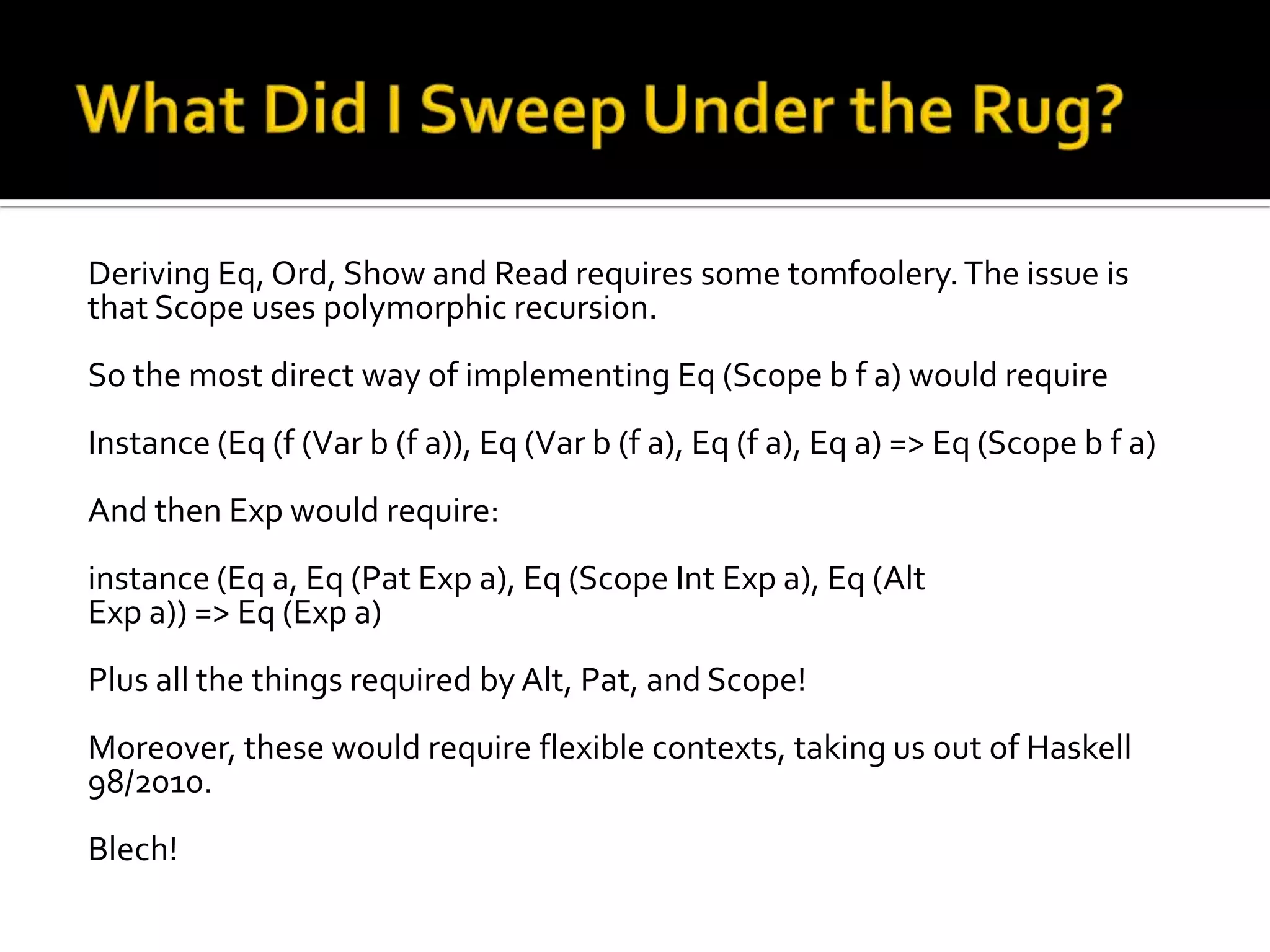
Deriving Eq, Ord, Show and Read requires some tomfoolery. The issue is
that Scope uses polymorphic recursion.
So the most direct way of implementing Eq (Scope b f a) would require
Instance (Eq (f (Var b (f a)), Eq (Var b (f a), Eq (f a), Eq a) => Eq (Scope b f a)
And then Exp would require:
instance (Eq a, Eq (Pat Exp a), Eq (Scope Int Exp a), Eq (Alt
Exp a)) => Eq (Exp a)
Plus all the things required by Alt, Pat, and Scope!
Moreover, these would require flexible contexts, taking us out of Haskell
98/2010.
Blech!
Slide 40 of 50 · ·
My prelude-extras package defines a number of boring typeclasses like:

class Eq1 f where
        (==#) :: Eq a => f a -> f a -> Bool
        (/=#) :: Eq a => f a -> f a -> Bool

class Eq1 f => Ord1 f where
 compare1 :: Ord a => f a -> f a -> Ordering

class Show1 f where
 showsPrec1 :: Show a => Int -> f a -> ShowS

class Read1 f where
 readsPrec1 :: Read a => Int -> ReadS (f a)
 readList1 :: Read a => ReadS [f a]
Slide 41 of 50 · ·
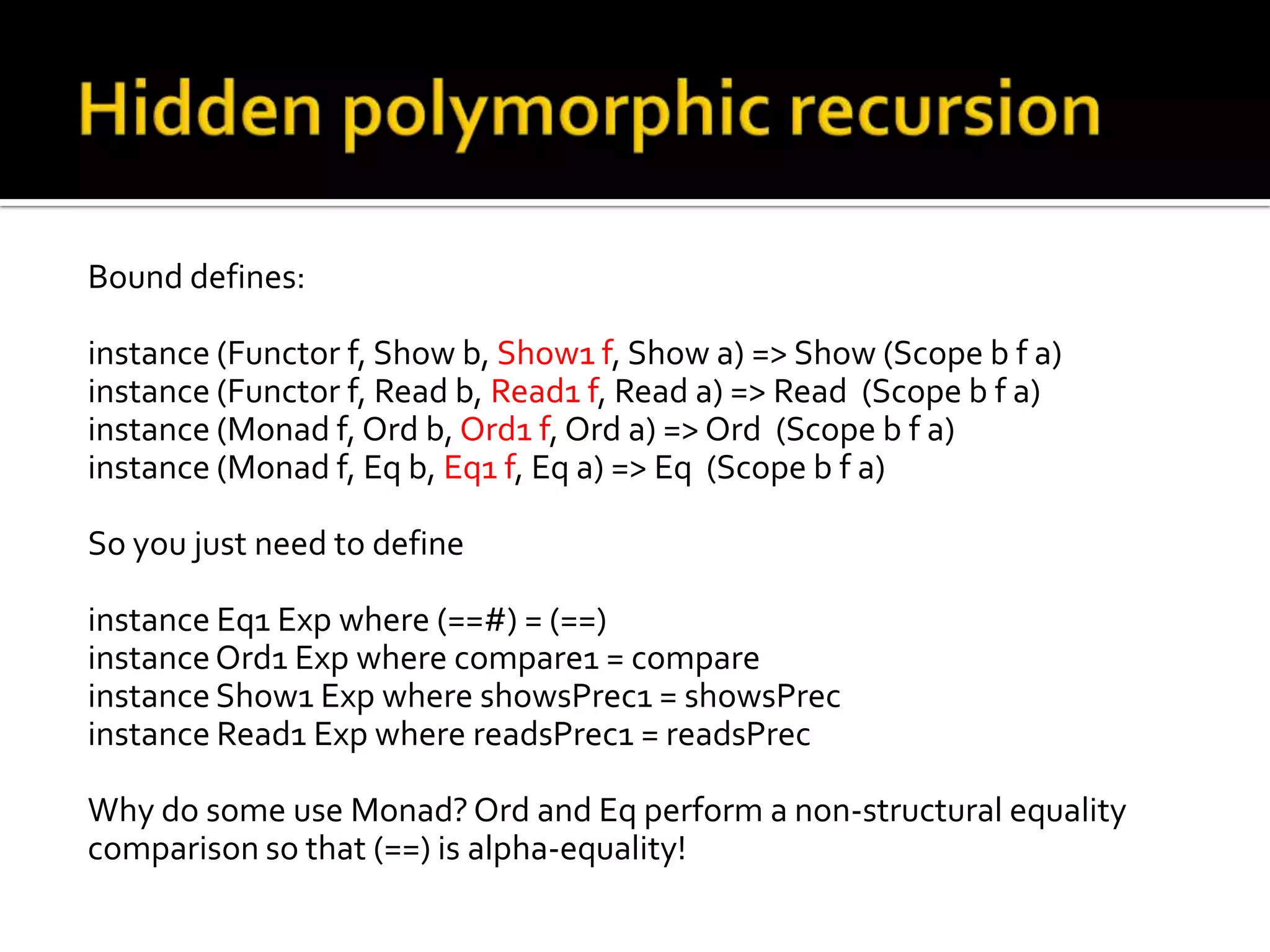
Bound defines:

instance (Functor f, Show b, Show1 f, Show a) => Show (Scope b f a)
instance (Functor f, Read b, Read1 f, Read a) => Read (Scope b f a)
instance (Monad f, Ord b, Ord1 f, Ord a) => Ord (Scope b f a)
instance (Monad f, Eq b, Eq1 f, Eq a) => Eq (Scope b f a)

So you just need to define

instance Eq1 Exp where (==#) = (==)
instance Ord1 Exp where compare1 = compare
instance Show1 Exp where showsPrec1 = showsPrec
instance Read1 Exp where readsPrec1 = readsPrec

Why do some use Monad? Ord and Eq perform a non-structural equality
comparison so that (==) is alpha-equality!
Slide 42 of 50 · ·
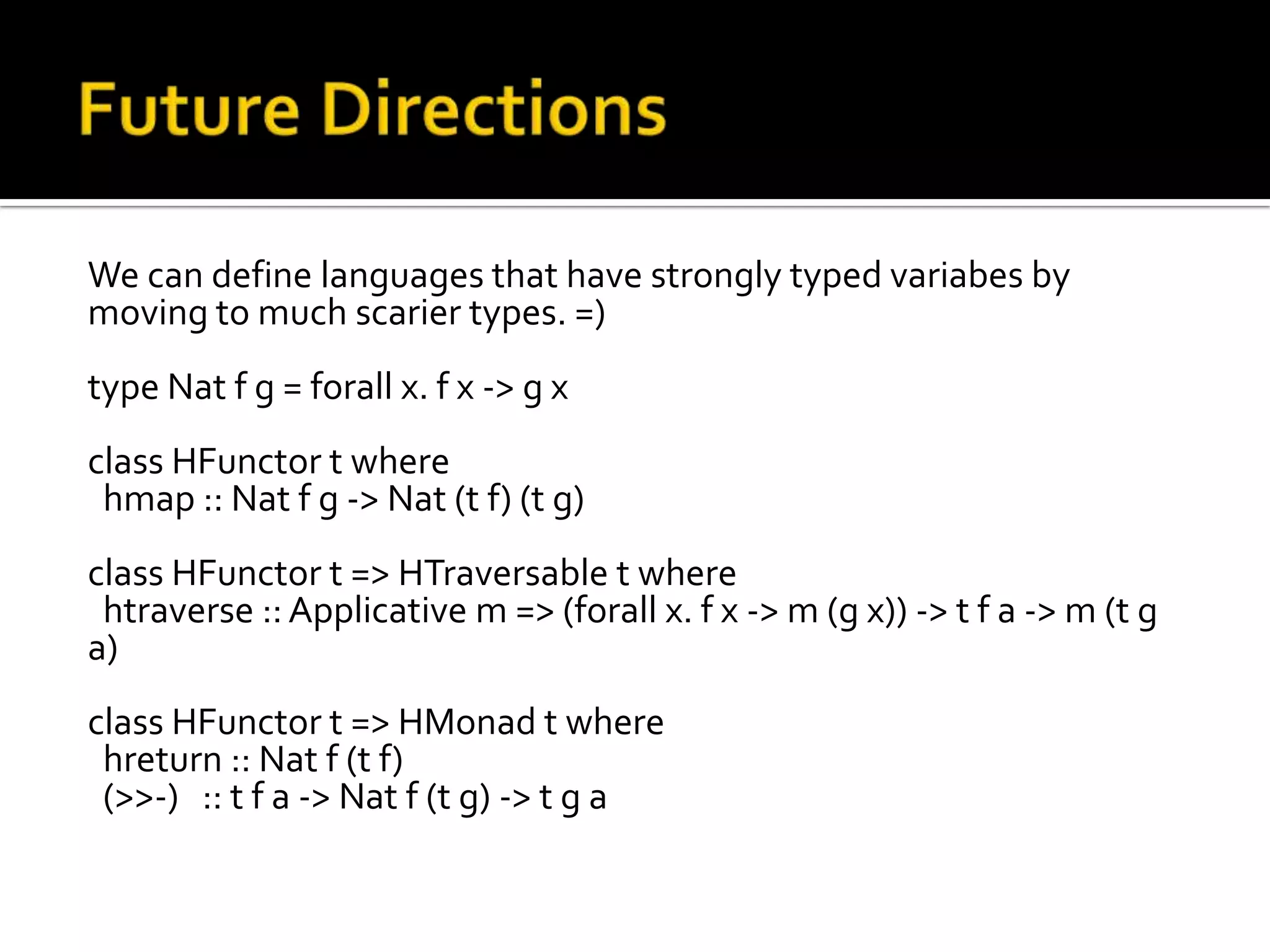
We can define languages that have strongly typed variabes by
moving to much scarier types. =)
type Nat f g = forall x. f x -> g x
class HFunctor t where
 hmap :: Nat f g -> Nat (t f) (t g)
class HFunctor t => HTraversable t where
 htraverse :: Applicative m => (forall x. f x -> m (g x)) -> t f a -> m (t g
a)
class HFunctor t => HMonad t where
 hreturn :: Nat f (t f)
 (>>-) :: t f a -> Nat f (t g) -> t g a
Slide 43 of 50 · ·
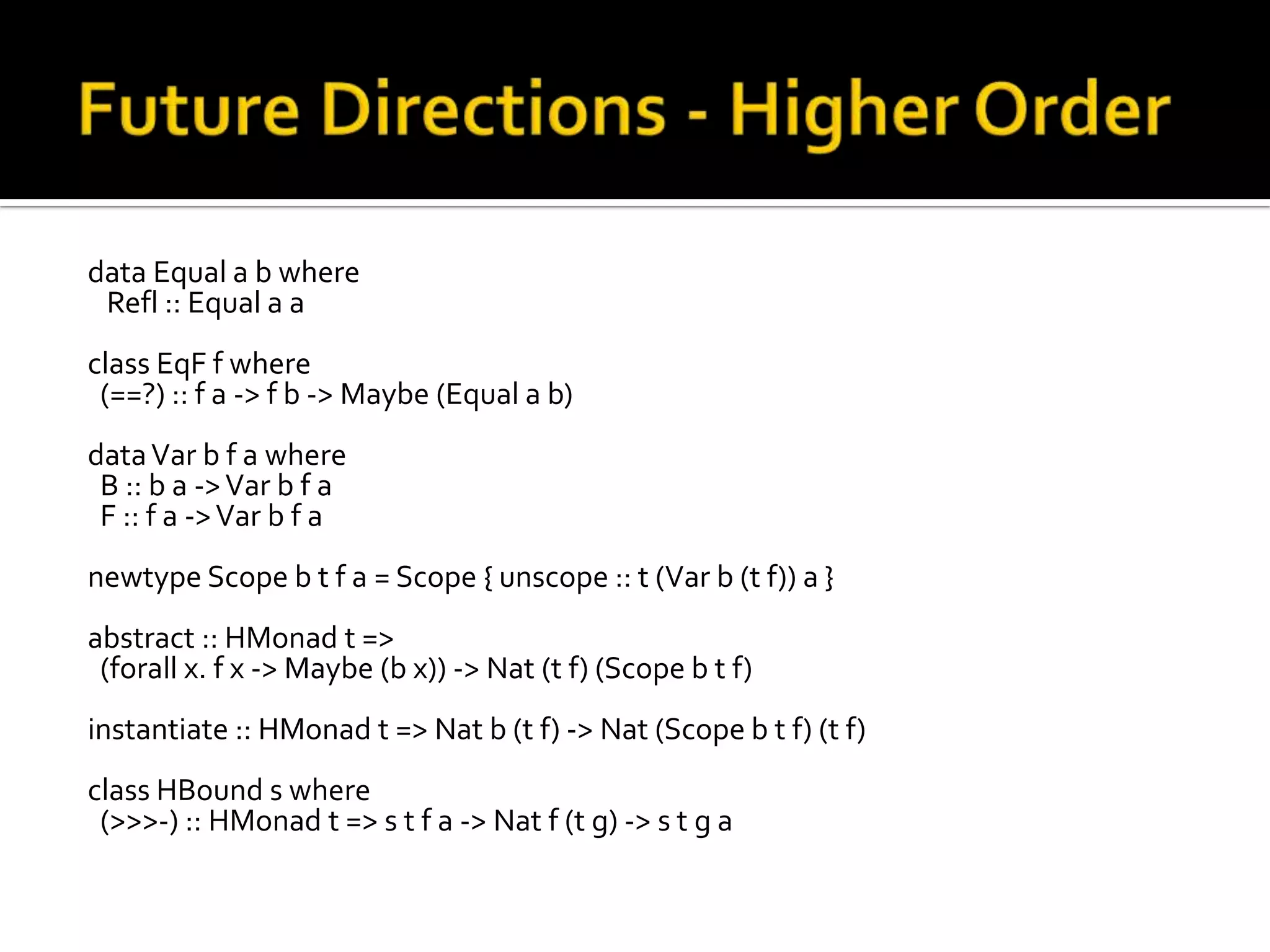
data Equal a b where
 Refl :: Equal a a
class EqF f where
 (==?) :: f a -> f b -> Maybe (Equal a b)
data Var b f a where
 B :: b a -> Var b f a
 F :: f a -> Var b f a
newtype Scope b t f a = Scope { unscope :: t (Var b (t f)) a }
abstract :: HMonad t =>
 (forall x. f x -> Maybe (b x)) -> Nat (t f) (Scope b t f)
instantiate :: HMonad t => Nat b (t f) -> Nat (Scope b t f) (t f)
class HBound s where
 (>>>-) :: HMonad t => s t f a -> Nat f (t g) -> s t g a
Slide 44 of 50 · ·
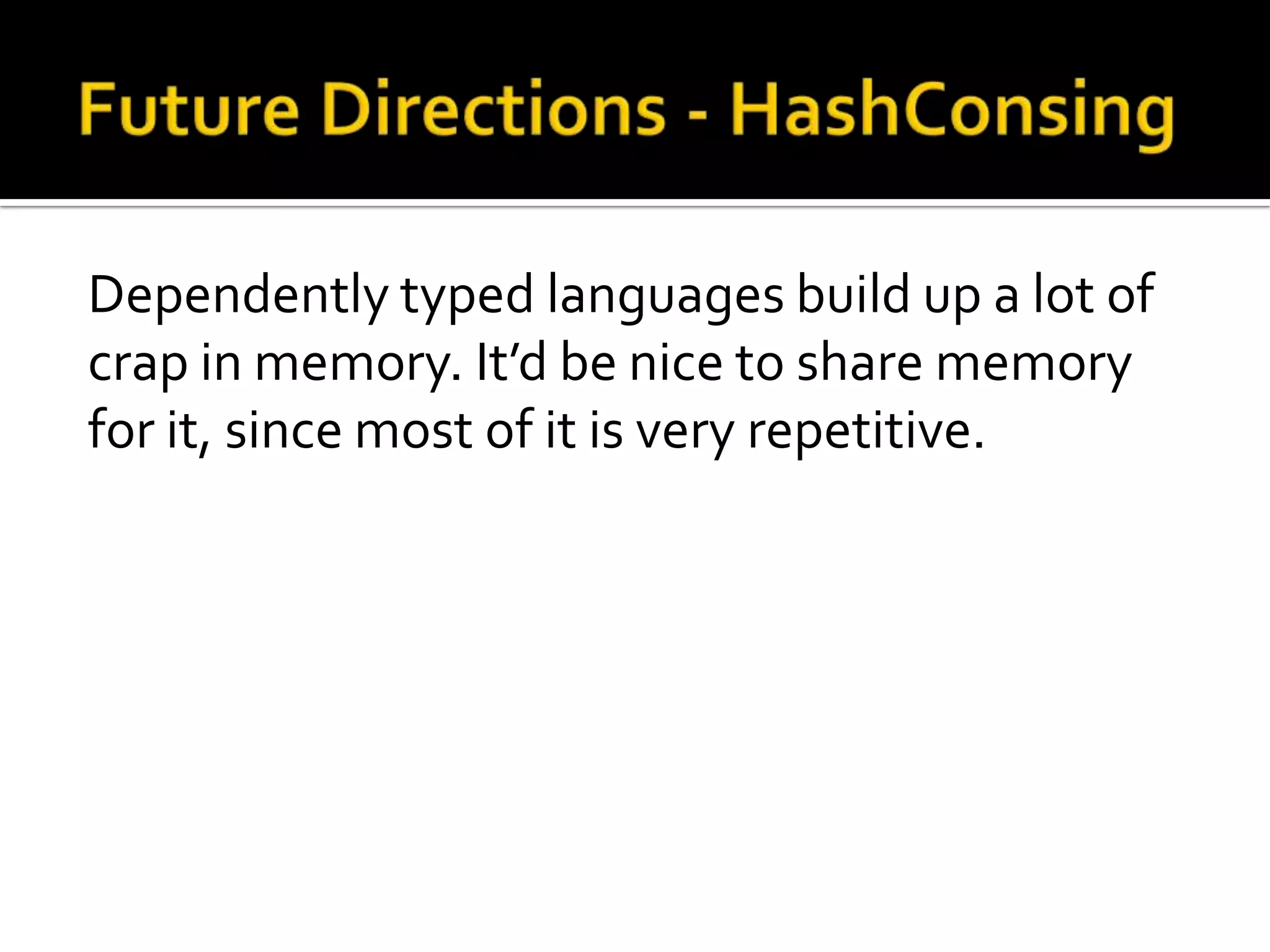
Dependently typed languages build up a lot of
crap in memory. It’d be nice to share memory
for it, since most of it is very repetitive.
Slide 45 of 50 · ·
 Bound provides a small API for dealing with
  abstraction/instantiation for complex binders
  that combines the nice parts of “I am not a
  number: I am a free variable” with the “de Bruijn
  notation as a nested data type” while avoiding
  the complexities of either.
 You just supply it a Monad and Traversable
 No variable supply is needed, no pool of names
 Substitution is very efficient
 Introduces no exotic or illegal terms
 Simultaneous substitution for complex binders
 Your code never sees a de Bruijn index
Slide 46 of 50 · ·
Slide 47 of 50 · ·
Slide 48 of 50 · ·
data Ix :: [*] -> * -> * where
 Z :: Ix (a ': as) a
 S :: Ix as b -> Ix (a ': as) b

data Vec :: (* -> *) -> [*] -> * where
 HNil :: Vec f '[]
 (:::) :: f b -> Vec f bs -> Vec f (b ': bs)

data Lit t where
 Integer :: Integer -> Lit Integer
 Double :: Double -> Lit Double
 String :: String -> Lit String

data Remote :: (* -> *) -> * -> * where
 Var :: f a -> Remote f a
 Lit :: Lit a -> Remote f a
 Lam :: Scope (Equal b) Remote f a -> Remote f (b -> a)
 Let :: Vec (Scope (Ix bs) Remote f) bs -> Scope (Ix bs) Remote f a -> Remote f a
 Ap :: Remote f (a -> b) -> Remote f a -> Remote f b
Slide 49 of 50 · ·
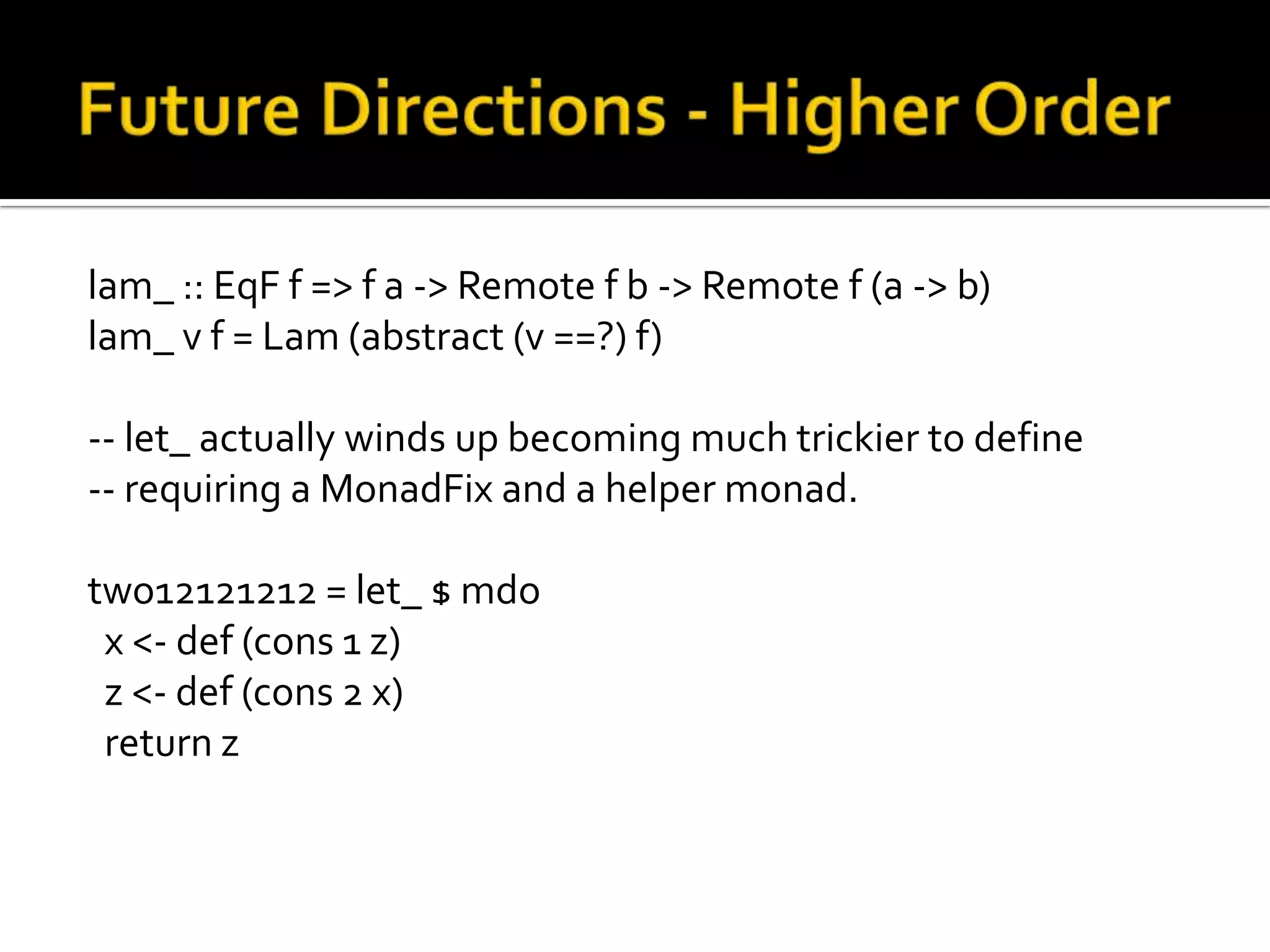
lam_ :: EqF f => f a -> Remote f b -> Remote f (a -> b)
lam_ v f = Lam (abstract (v ==?) f)

-- let_ actually winds up becoming much trickier to define
-- requiring a MonadFix and a helper monad.

two12121212 = let_ $ mdo
 x <- def (cons 1 z)
 z <- def (cons 2 x)
 return z
Slide 50 of 50 ·